- UNDP advanced environmental justice through legal analysis, policy dialogue and capacity-building, including training more than 50 judges and prosecutors, and producing a landmark study on environmental crime that is informing stronger prosecution and adjudication practices.
- Social cohesion and transitional justice were strengthened by empowering youth, women and civil society, supporting services for over 1,000 war victims, engaging more than 1,400 people in dialogue and confidence-building, and reaching over 250,000 people through awareness campaigns.
- Security and resilience improved through enhanced cyber security frameworks, stronger regional cooperation on small arms control, the destruction of over 1,500 weapons, and the promotion of gender-responsive policing and cross-border collaboration among law enforcement actors.
Over 2022–2025, Bosnia and Herzegovina continued to face structural challenges across the rule of law, justice, security and human rights sectors, shaped by its complex governance framework and rising political tensions. The granting of the European Union (EU) candidate status in December 2022 underscored the need to align national legal and institutional systems with the EU acquis communautaire. At the same time, political instability persisted, intensifying from 2021 and culminating in a constitutional crisis in 2025.
In 2024, Bosnia and Herzegovina submitted its fourth Universal Periodic Review on the Human Rights Situation to the UN Human Rights Council. In its contribution, the UN Country Team noted discrimination, shrinking civic space, impunity for hate crimes, concerns about judicial independence and limited access to free legal aid. Environmental governance also remained fragmented across multiple levels of authority, creating inconsistencies in implementation and oversight.
Against this backdrop, UNDP supported national authorities in aligning domestic legislation with the EU acquis, particularly in environmental justice and cyber security. UNDP also strengthened institutional capacities to combat environmental crime, address cyber security threats and ensure the safe management of ammunition stockpiles.
In parallel, UNDP advanced youth engagement and women’s leadership to promote social cohesion and support dialogue and reconciliation under the transitional justice framework. Following the High Judicial and Prosecutorial Council’s receipt of the Silver Gender Equality Seal, UNDP supported the Ministry of Security of Bosnia and Herzegovina in pursuing the same certification process, with plans to extend the initiative to two local governments in 2026. In late 2025, UNDP also launched the first round of a national Social Cohesions and Resilience (SCORE) Index survey, which will generate insights into societal resilience to ethnic and religious tensions, political violence and civic apathy, and help inform future policy and programming.
In 2025, UNDP continued working under the Green Transition Portfolio, building on the Eco-Justice Project supported by the Netherlands. The portfolio integrates legal analysis, capacity-building and policy dialogue with key justice-sector partners. A landmark analysis Criminal Offences against the Environment in Bosnia and Herzegovina – Legal Framework and Case Law highlighted systemic challenges in prosecution and adjudication of environmental harm. UNDP also delivered training on the EU environmental law and relevant European Court of Human Rights case law for more than 50 judges and prosecutors, with judicial training centres now set to scale up these programmes.
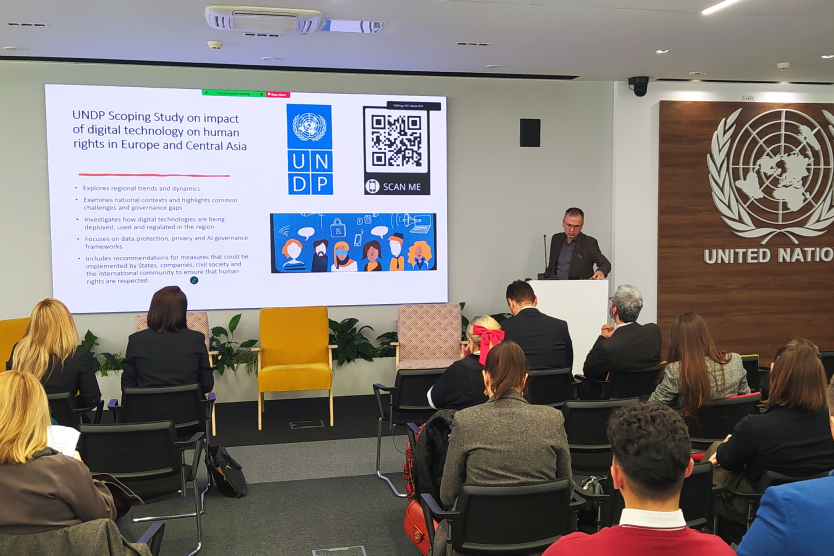
A multi-partner conference on the impact of digital technologies, including AI, on human rights.
and Herzegovina
UNDP strengthened cyber-security readiness in Bosnia and Herzegovina by supporting alignment of the legal framework with the EU cyber-security directives, establishing Computer Emergency Response Teams and piloting a master’s programme on cyber security at the University of Sarajevo. Importantly, in 2025 UNDP initiated a policy dialogue on human rights implications of emerging technologies, with specific focus on a human rights-based approach to digital and artificial intelligence (AI) transition. Following the high level workshop and training organized, UNDP has developed a concept note for advancing responsible AI use in public institutions in Bosnia and Herzegovina.
To support transitional justice, social cohesion and human rights, UNDP supported nine civil society organizations (CSOs), providing psychological counselling, legal aid and other services to more than 1,000 war victims. Their initiatives engaged youth, women and communities in education, advocacy and dialogue, involving over 1,410 people in confidence-building activities. CSOs also facilitated intergenerational exchanges between war victims and youth and conducted awareness campaigns reaching more than 250,000 people, strengthening public understanding of human rights and transitional justice. Regional cooperation in war-crimes cases was enhanced through peer-to-peer judicial platforms, enabling case transfers and advancing 24 trials of previously at-large suspects.
In 2025, a cross-border exercise brought together prosecutors, police and customs officers from Bosnia and Herzegovina and Serbia to enhance cooperation against the illicit trafficking of small arms and light weapons (SALW). UNDP advanced gender-sensitive approaches across the security sector by supporting joint capacity-building for women police associations from Bosnia and Herzegovina and Serbia. Guidelines on SALW investigative techniques were delivered to three police training institutions. Awareness-raising activities included the award-winning youth film The Game, screened to 17,000 students, and the theatre play Echo of Silence, reaching nearly 3,000 people. More than 1,500 small arms and light weapons were destroyed, reducing public-safety risks.
In 2026 and beyond, UNDP will advance environmental justice in Bosnia and Herzegovina by strengthening the skills of judges, prosecutors and police, promoting guidance on environmental crimes and raising awareness of environmental rights, while reinforcing coordination across institutions.
Working with UNESCO and UN Women, UNDP will counter hate speech and divisive narratives, and through the Gender Accelerator Programme with UN Women, UNICEF and UNFPA, UNDP will support law enforcement in addressing gender-based violence. The Gender Equality Seal process for the Ministry of Security will be completed, with pilots at the local level.
UNDP will continue supporting transitional justice. A joint Peacebuilding Fund programme will be developed in collaboration with civil society and the UN Human Rights Office to foster inclusive dialogue and rebuild trust.