
Central African Republic
Countries & Territories


Key results
- The Special Criminal Court issued its second judgment in the Ndélé massacre case, convicting four individuals for crimes against humanity and war crimes (the judgment is currently under appeal). In another case (Paoua massacre), nine direct victims (including five sexual violence survivors) and 32 families affected by the attack on the villages, received financial reparations, marking a historic milestone in the fight against impunity in the Central African Republic (CAR).
- UNDP’s support to national institutions helped increase access to justice for girls and women in CAR. For instance, the number of beneficiaries of the Joint Rapid Intervention and Repression Unit for Violence Against Women and Children increased by almost 2,000 compared to the previous year. Over 21,000 people, most of them women and girls, received protection and legal aid.
- To support the security sector reform and to ensure that security forces adopt community policing, UNDP delivered training for the internal security forces and strengthened legal frameworks to enhance transparency, accountability and oversight.
Since 2020, the Central African Republic (CAR) has seen gradual improvements in governance, security and the rule of law, following decades of violent conflict. Many regions formerly controlled by armed groups have been reclaimed, and state authority has slowly returned. However, residual insecurity, underdevelopment and a fragile institutional environment remain.
The crises of the past, particularly in 2013 and the recent crisis in 2021, negatively affected CAR’s development trajectory. Armed groups systematically targeted state officials and infrastructure, disintegrating justice and security institutions. These dynamics, compounded by poor governance, politicized security forces and regional inequalities, created widespread feelings of marginalization and contributed to a cycle of impunity.
In 2024, CAR took key steps to strengthen its path to sustainable development. The adoption of the National Development Plan (NDP) for 2024-2028 marked a strategic shift from humanitarian assistance to long-term development, serving as the blueprint for CAR’s development path, including in justice and security sectors. Despite these gains, resource mobilization remained difficult due to global crises, including instability in neighboring Sudan and overall decline in development funding.
The Joint Rule of Law Programme in CAR is one of the flagship UN joint programme modalities operationalized through the UN Global Focal Point for the Rule of Law (GFP). The programme is implemented by UNDP and the UN Multidimensional Integrated Stabilization Mission in CAR (MINUSCA) in cooperation with the Team of Experts on Rule of Law and Sexual Violence in Conflict (ToE). This ‘One-UN’ approach facilitates resource mobilization and allows the UN to leverage the comparative advantages of different agencies and work towards common objectives.
In 2024, UNDP’s Rule of Law, Justice and Security portfolio in CAR focused on reinforcing justice institutions, strengthening transitional justice and supporting security sector reform as part of efforts to restore state authority and build sustainable peace. Despite sociopolitical and security constraints, the portfolio made critical contributions through both technical and financial support, in close coordination with the Government and key partners.
UNDP played a central role in advancing transitional justice through continued support to the Special Criminal Court (SCC) which delivered its second judgment in the crimes against humanity and war crimes case (Ndélé 1 case) in December 2024, and launched its third trial (in Ndélé 2 case) in June 2024. In the Paoua case, financial reparations were paid to victims of war crimes and crimes against humanity, including five survivors of sexual violence and 32 families. For the first time, the SCC awarded financial reparations to victims, contributing to breaking the cycle of impunity and responding to the long-standing demands for justice and accountability in CAR. In parallel, legal aid was provided to 15 victims, and 48 detainees received medical assistance.
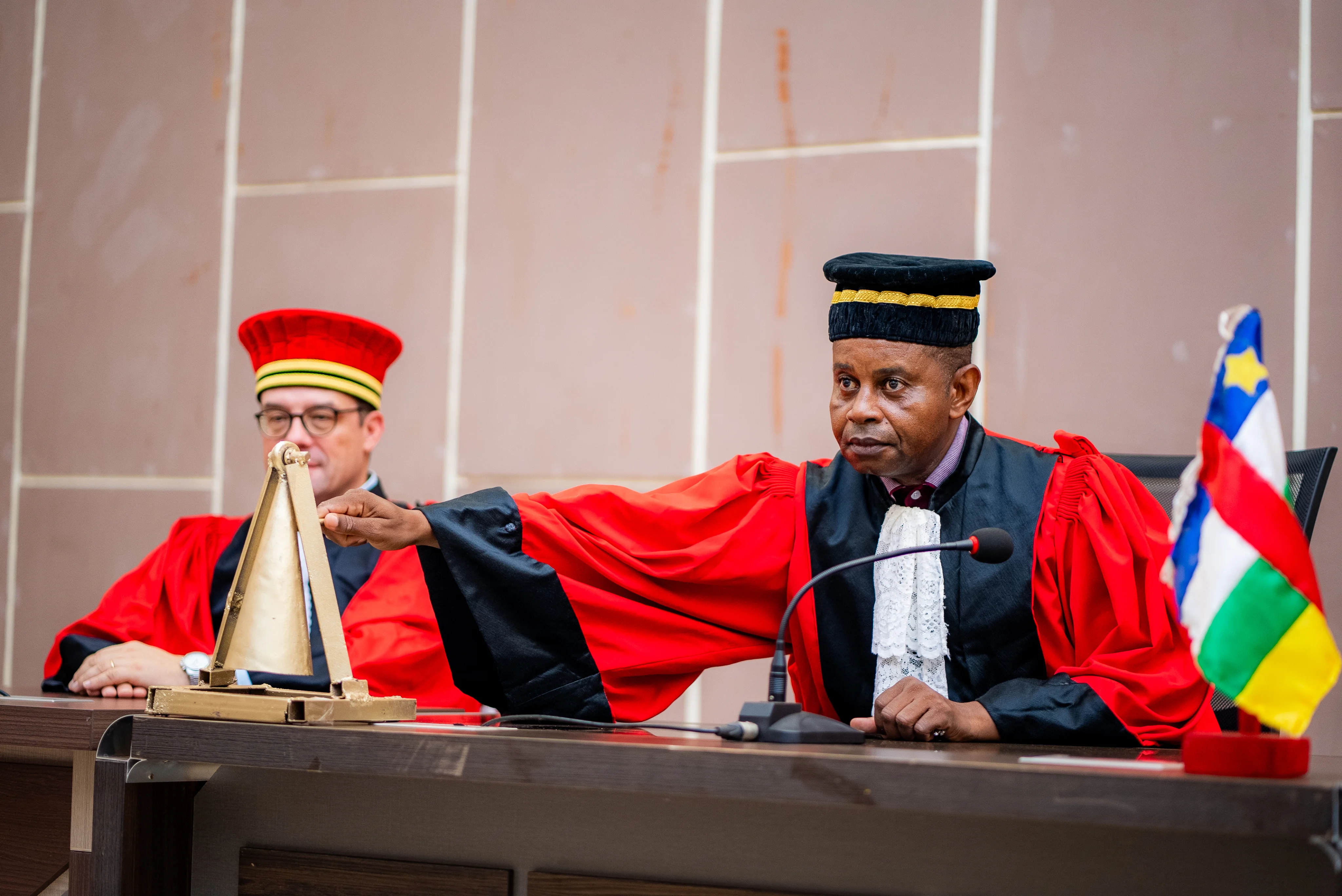
Judges of the Special Criminal Court in the Central African Republic.
The UN joint programme modality implemented under the Global Focal Point arrangement will continue its efforts in restoring the state authority and breaking the cycle of impunity in CAR through investing in people-centred justice, security, sustainable peace and development.
The portfolio will also strengthen its support to accountability and transitional justice process in CAR through providing support to the SCC as well as to the Truth, Justice, Reconciliation and Reparation Commission(CVJRR). As we hope to support the SCC to accelerates its work, it will be essential to mobilize the resources and secure sustained political support to ensure the court operates effectively and delivers high-impact results.
Looking forward
The UN joint programme modality implemented under the Global Focal Point arrangement will continue its efforts in restoring the state authority and breaking the cycle of impunity in CAR through investing in people-centred justice, security, sustainable peace and development.
The portfolio will also strengthen its support to accountability and transitional justice process in CAR through providing support to the SCC as well as to the Truth, Justice, Reconciliation and Reparation Commission(CVJRR). As we hope to support the SCC to accelerates its work, it will be essential to mobilize the resources and secure sustained political support to ensure the court operates effectively and delivers high-impact results.
* Country profiles marked as GFP detail results achieved under the framework of the Global Focal Point for the Rule of Law, a UN partnership mechanism coordinated by UNDP and the UN Department of Peace Operations