
South Sudan
Countries & Territories


Key results
- Key transitional justice mechanisms were established, including the Commission on Truth, Reconciliation and Healing and the Compensation and Reparations Authority. Forty-five new victim support groups were established, comprising 2,326 members, including over 1,160 women.
- Over 17,000 individuals received access to justice through courts and police protection units, and over 8,000 people (half of them women) benefitted from legal aid.
- Community safety was strengthened by operationalizing 259 Police and Community Relationship Committees, including 38 led by women, contributing to crime reduction and improved police-community collaboration.
In 2024, South Sudan continued to experience a number of challenges: economic, political complexities, worsening humanitarian conditions and intensified inter- and intra-communal conflicts across the country. The implementation of the Revitalized Agreement on the Resolution of the Conflict in the Republic of South Sudan (R-ARCSS) remained slow, with the transitional period extended to 2026, delaying key milestones. Critical institutions such as the National Elections Commission (NEC), National Constitution Review Commission (NCRC) and Political Parties Council (PPC) were reconstituted, while progress on certain transitional justice mechanisms was yet to be accelerated.
Under Phase III of its Access to Justice, Security and Human Rights Strengthening Programme, UNDP supported transitional justice, human rights, constitution-making and judicial reforms in South Sudan as part of the R-ARCSS implementation.
UNDP engaged in advocacy and preparatory work to promote a people-centred and gender-responsive constitution. The Reconstituted National Constitutional Review Commission became operational with 57 members nominated and sworn in. The next steps will include nationwide civic education and the formation of the bodies that would draft and validate the text of the constitution.
To further support the judicial reform, UNDP mobilized joint assistance to nationwide consultations coordinated by the ad hoc Judicial Reform Committee. The Committee’s final report was validated as one of the strong sources that will inform the permanent constitution.
UNDP also contributed to the transitional justice process by supporting the presidential assent of the Commission on Truth, Reconciliation and Healing, as well as the Compensation and Reparations Authority Bills. To ensure inclusive participation, 45 new victim support groups were created in 2024, comprising 2,326 members, including over 1,160 women, bringing the total to 127 victim support groups with over 6,400 participants, including 2,146 women, ready to engage in the transitional justice process.
Efforts to expand access to legal information and redress mechanisms reached over 8.1 million people (40 percent women) through community engagement, in-person outreach and radio broadcasts. To achieve that, UNDP partnered with 31 civil society organizations and media outlets.
A total of 17,147 individuals, including over 4,180 women, accessed justice services via specialized Gender-Based Violence Courts, County and High Courts, Police Special Protection Units, as well as pretrial release mechanisms. Additionally, over 8,000 people (53 percent women) received legal aid services, with many women seeking advice on culturally sensitive issues such as divorce, property rights and gender-based violence. Over 2,600 women reported gender-based violence at Special Protection Units and received legal, prosecutorial and psychosocial support.
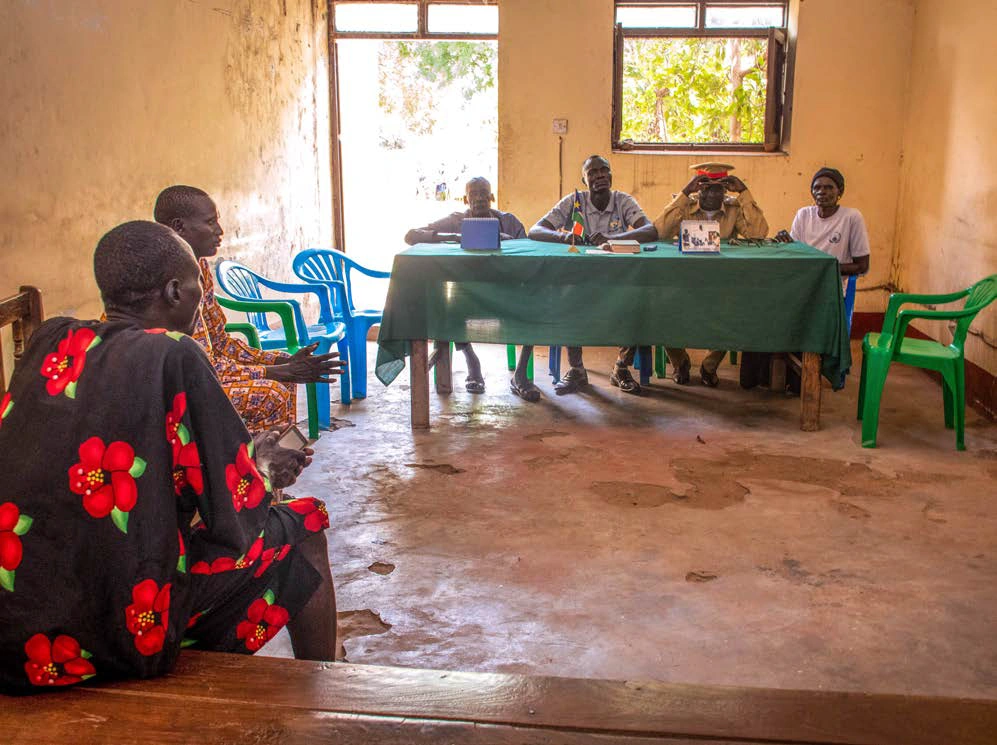
A court session in Terekeka, South Sudan.
To further support vulnerable groups, UNDP delivered vocational training to 1,247 inmates, including 189 women, across three prison-based centres, contributing to rehabilitation and reintegration. Over 3,000 individuals have been trained to date, with no recorded recidivism among graduates.
UNDP advanced community security by operationalizing 259 Police and Community Relationship Committees in collaboration with communities and the police. Notably, 38 committees were led by women, contributing to crime reduction and improved safety.
All efforts were designed to be nationally owned, rights-based and gender responsive, and were implemented in collaboration with government institutions, civil society, media, UN agencies and regional bodies including the United Nations Mission in South Sudan (UNMISS), UN Women, OHCHR, UNHCR, the African Union (AU) and the Inter-governmental Authority on Development (IGAD).
Looking forward
UNDP will advance nationally led, sustainable and rights-based initiatives to strengthen justice and protection for vulnerable groups. It will focus on building accountable and gender-responsive justice and security institutions, ensuring equal access to justice, especially for women, girls and violence survivors, and improving community safety in conflict-affected areas. Additionally, UNDP will support national human rights systems and further contribute to establishing transitional justice mechanisms to address past abuses and the root causes of conflict.