

Yemen
Countries & Territories


Key results
- UNDP significantly improved conditions for 61 women detainees and 41 accompanied children in custody through infrastructure upgrades, legal aid, and psychosocial support, in partnership with UNICEF, reinforcing the Humanitarian-Development-Peace Nexus.
- Legal empowerment initiatives led by the Yemen Women Union, supported by UNDP, assisted 450 legal cases, directly benefiting 145 women and contributing to systemic improvement in both formal and informal justice systems.
- UNDP strengthened inclusive justice mechanisms by institutionalizing community-based platforms and formalizing cooperation between civil society and government through endorsed Standard Operating Procedures, promoting sustainable, people-centered access to justice.
In Yemen, where the crisis is deepening and poverty is raging, UNDP emphasized the importance of development to address the key drivers of the conflict and to avoid irreversible losses. In 2023-2024, UNDP in Yemen implemented a project “Planning a Comprehensive Approach to Prison Programming” supported through UNDP’s Global Programme for Strengthening the Rule of Law, Human Rights, Justice and Security for Sustainable Peace and Development (the Global Programme). The project contributed to the achievements of the broader rule of law portfolio in Yemen, proving that promoting people-centred justice remains a crucial avenue for development-oriented crisis response.
Through integrated responses and the interagency collaboration between UNDP and UNICEF, the project improved the lives of women detainees and children who stay with them in a prison. This partnership strengthened the Humanitarian, Development and Peace (HDP) Nexus, highlighting the need to protect detainees through early development interventions.
Based on a joint needs assessment of 261 women detainees and their 41 children who stay with them, essential infrastructure improvements ensured 24-hour water supply to the women’s section and increased bathroom capacity by 70 percent. In addition, a UN Service Building was successfully constructed to provide life-sustaining services. The project has catalysed a longer-term commitment by UNICEF to provide health, psychosocial and educational services together with UNDP-led legal and economic empowerment.
By addressing the immediate needs of women detainees, the project boosted actions to overcome systemic obstacles for women seeking justice in Yemen, who have long been suffering from unaccountable informal justice channels, as well as expensive and inaccessible formal mechanisms.
Through legal empowerment services, women lawyers from the Yemen Women Union (YWU), in collaboration with community justice workers and relevant authorities, assisted 450 legal cases from February to July 2024. Women were beneficiaries in 145 of these cases. To assess the quality of legal help, women lawyers were also appointed as monitoring agents.
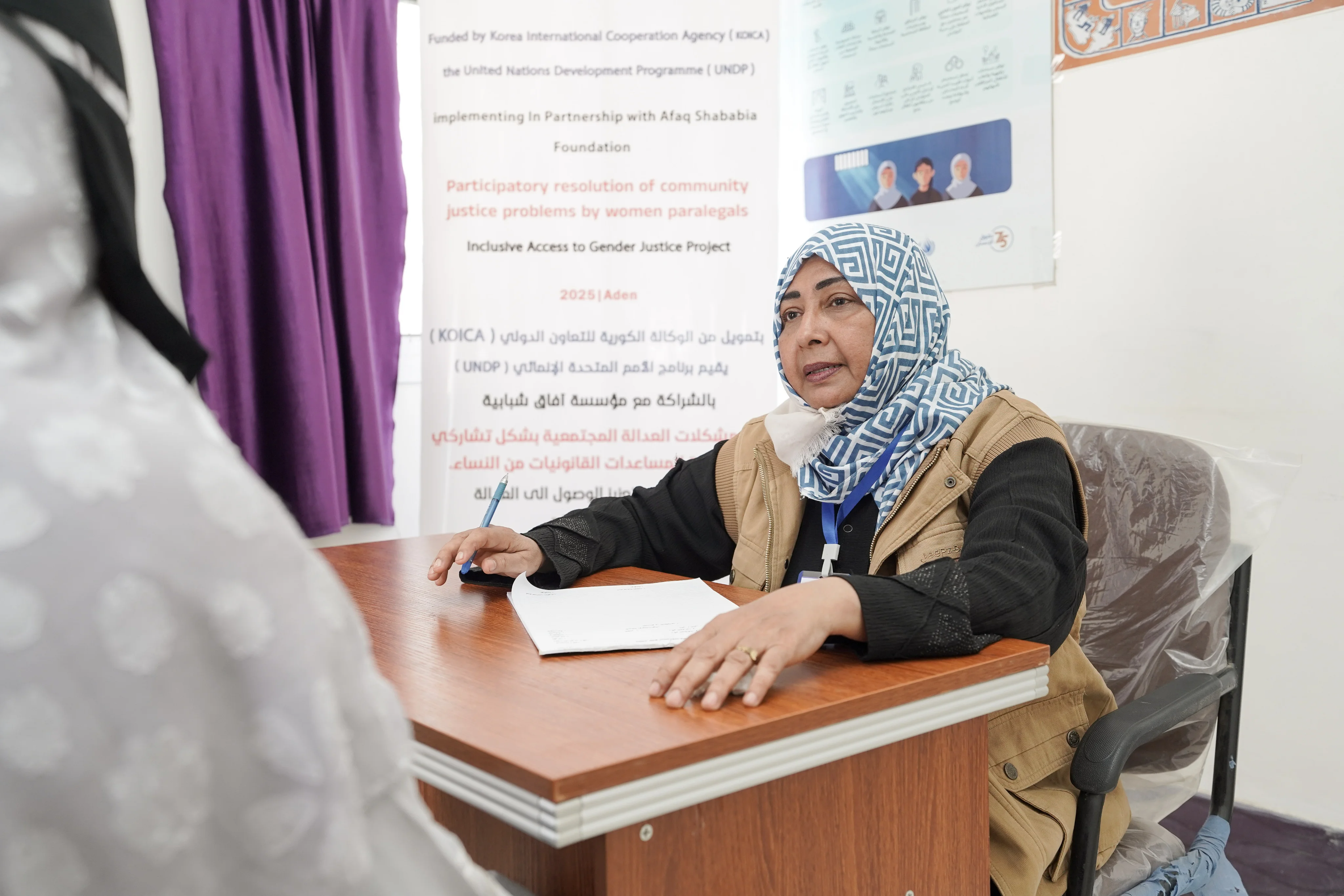
A community mediator is providing restorative justice service to a beneficiary.
In one case, the mother of a female detainee visited the prison every day, mistakenly believing that the prison staff has the power to release her daughter. Lacking the financial means to hire a private lawyer, she was misled by people who exploited her situation, resulting in a significant loss without a solution. The YWU’s legal empowerment team discovered that the female detainee had already been proven innocent and received a release order, but nobody took action to release her. Through the YWU’s tireless efforts, the detainee was finally released and her mother was saved from hopelessly waiting at the prison gate.
Many imprisoned women had been charged with “Az Zina’a” (adultery), an accusation often used by men to silence women’s voices. In addition, families tend to reject these women, and they cannot be released without a family member taking them home. One woman spent additional seven years in a prison after completing her sentence. In coordination with penitentiary authorities, UNDP supported the legal empowerment team at the YWU to reconcile the woman with her family. Eventually, she was released when her two sons came to receive her. In another similar case, the YWU obtained a referral letter from the Prosecutor’s Office, which enabled the detainee to be released and accommodated at a women’s shelter run by the YWU.
To improve gender justice in Yemen, UNDP undertook a comprehensive approach across informal and formal justice systems. An informal community-based justice platform became more inclusive, with almost quarter of its 400 members represented by women, internally displaced persons, persons with disabilities and individuals belonging to Muhamasheen caste group. To guarantee the sustainability of this inclusive approach, a Community Charter was developed incorporating mandatory quotas for diversity, as well as accountability measures, such as a code of conduct and a complaint mechanism.
Through a Joint Committee platform, comprising key civil society and public authorities, including the YWU and the local branches of the Ministry of Justice, Ministry of Interior, Ministry of Social Affairs and Labour, UNDP improved a policy framework for access to informal and formal justice at the governorate level. While the committee initially faced reluctance from formal institutions, particularly in moving beyond their conventional roles, the focus on the transformative impact of legal empowerment eventually gained their support. The committee successfully developed and endorsed Standard Operating Procedures (SOPs) for legal empowerment, emphasizing community mediation and people-centred access to justice. This collaborative process stands as a valuable lesson in overcoming initial resistance to achieve meaningful system-level change.
The targeted interventions funded by the Global Programme boosted UNDP’s understanding of and collaboration with prison authorities, unlocking case referrals from the formal rule of law institutions to informal legal empowerment initiatives based on civil society and communities. In addition, gender justice capacity was strengthened at district courts by operationally activating the Women Litigant Units, providing office equipment, establishing referral pathways to social services, such as the YWU, and facilitating the inauguration by the Ministry of Justice.
Looking forward
UNDP launched follow-up activities with the YWU to continue its protection services for vulnerable women and children, including through a new women’s shelter, while UNICEF has committed its resources to commence health and educational services at the UN Service Building. The inter-agency partnership and service referral pathways it fostered are expected to grow beyond the funding duration from the Global Programme. At the end of the project, having witnessed the life-changing impact of legal empowerment assistance, authorities represented at the Joint Committee also shared a consensus about the importance of people-centred services.