
Mali
Countries & Territories


Key results
- PROSMED supported major national reforms, including the adoption of a new Penal Code and Code of Criminal Procedure, and strengthened justice institutions, contributing to improved access to justice and alignment with international human rights standards.
- Land commissions (CoFos) were empowered, leading to the peaceful resolution of 433 land disputes and the official recognition of 81 conciliation agreements by courts, while over 106,000 people were sensitized on land rights and justice mechanisms.
- Community-based security initiatives helped to reduce crime and rebuild trust between citizens and security forces, with residents reporting a significant drop in attacks in previously high-risk areas.
- Through training and media engagement, PROSMED promoted alternative narratives to violent extremism, enabling journalists and influencers to disseminate messages aligned with the National Policy on the Fight against Violent Extremism, contributing to more peaceful and inclusive public discourse.
In 2024, UNDP in Mali continued to play a pivotal role in strengthening the rule of law and promoting conflict prevention through the PROSMED joint programme (Support Programme for the Stabilization of Mali through the Strengthening of the Rule of Law). The programme, jointly implemented by UNDP, UN Women and the United Nations Office on Drugs and Crime (UNODC), operates within the framework of the UN Global Focal Point for the Rule of Law (GFP), which in turn facilitates the coordinated UN support to rule of law institutions in crisis-affected settings.
This year was marked by significant political and security developments, including the organization of the Inter-Malian Dialogue for Peace and National Reconciliation, which aimed to provide solutions to restore peace and social cohesion through national consultations. This dialogue resulted in key recommendations, including the proposal to extend the transition period and creating conditions to hold inclusive national elections. These developments occurred in the context of Mali’s effective withdrawal from the Economic Community of West African States (ECOWAS) and the formation of the Alliance of Sahel States (AES) with Burkina Faso and Niger.
Against this backdrop, PROSMED continued the implementation of its activities and achieved results. One of the programme’s most impactful contributions was its support to implement and operationalize several national strategies that had been developed with its assistance in previous years. These include the National Strategy for Security Sector Reform, the National Strategy for Reconciliation and Social Cohesion, and the 2022-2026 Action Plan of the National Policy for the Prevention and Fight Against Violent Extremism and Terrorism. This support significantly enhanced the coherence and coordination among national and international actors working to strengthen the rule of law in Mali.
A major milestone in 2024 was the programme support to the reform of the justice sector. UNDP supported the National Transitional Council (CNT) in reviewing and adopting the new Penal Code and Code of Criminal Procedure, which were promulgated by the President of the Transition in December 2024. These legal texts introduced major innovations that improve access to justice and align Mali’s legal framework with international human rights standards.
In addition to legal reforms, PROSMED continued its support to the Ministry of Justice and Human Rights to implement the Justice Sector Orientation and Programming Act. This partnership has led to improved planning and coordination among justice sector stakeholders. The programme also strengthened the operational capacities of the Specialized Judicial Centre for Terrorism and Transnational Organized Crime Repression by equipping it with a solar power backup system and furnishing a courtroom to enable regular and well-conducted hearings. Furthermore, seven missions were conducted to monitor the indictment chambers, with recommendations for improvement submitted to the authorities.
At the community level, PROSMED made significant strides in promoting access to justice and conflict resolution. The programme revitalized land commissions (CoFos) and strengthened their role in resolving land disputes. Over 106,000 people, including 38,000 women and youth, were sensitized on the relationship between CoFos and the justice system. These efforts led to the peaceful resolution of 433 disputes and the official recognition of 81 conciliation reports by the courts. The programme also supported local initiatives to empower CoFos through peace infrastructures established in previous years, thereby reinforcing their legitimacy and contributing to social stabilization.
PROSMED also played a key role in supporting the deployment and integration of security forces in local communities. The construction of the Yelimane police station is ongoing, with provisional acceptance expected by the end of May 2025.
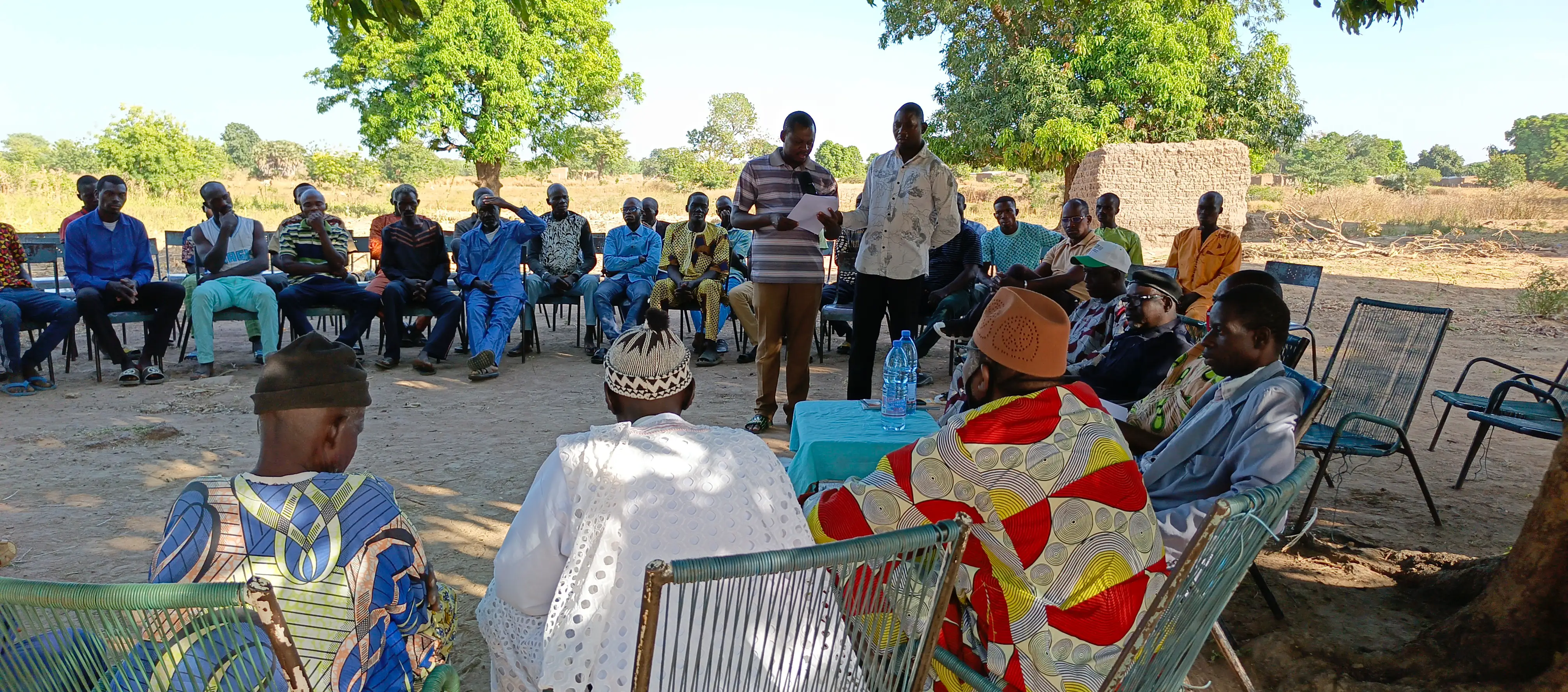
Local action to strengthen collaboration between the new police force and the community. Yorosso Commune, Lébosso neighborhood.
Through the construction and rehabilitation of security infrastructure and the organization of over 36 community engagement activities, including sports events, road safety campaigns and monthly meetings of security advisory committees, the programme helped rebuild trust between citizens and security actors. A testimonial from Koutiala highlighted a significant reduction in local crime due to increased community vigilance and cooperation with security forces.
“Before, in our town – especially around municipal stadium– there were attacks almost every day. But now, thanks to the awareness sessions from PROSMED, people in the community – men, women and youth – have really stepped up. Everyone’s more alert and ready to report anything suspicious.”
In the fight against violent extremism, PROSMED supported alternative narratives by training 50 journalists, bloggers and influencers on the National Policy for the Prevention and Fight against Violent Extremism and Terrorism. As a result, 12 media professionals, including five women, began promoting the policy through radio and blog content, while national television aired two programmes on the subject. These efforts contributed to a noticeable improvement in religious discourse, which became increasingly free of extremist language.
Access to justice for vulnerable populations remained a priority. In partnership with the Mali Bar Association, the programme provided legal aid to pre-trial detainees and survivors of gender-based violence. In Mopti prison, three in four of identified detainees received legal assistance, resulting in a resolution of over 83 percent of cases. Additionally, 387 litigants, most of them women, received legal support from trained paralegals, and 32 victims of human rights violations, including 23 women, were assisted by legal professionals.
PROSMED adopted a people-centred approach, with a strong emphasis on gender and youth inclusion. At least 30 percent of all project activities involved women and young people. A total of 595 CoFo members, nearly half of whom were women and youth, received training on their roles and responsibilities.
To ensure local ownership and sustainability, PROSMED partnered with the National Centre for the Promotion of Volunteering to deploy community volunteers in each intervention area. These volunteers supported local authorities in monitoring project activities. The programme also collaborated with local civil society organizations to follow up on the actions of state authorities.
The catalytic funding from UNDP’s Global Programme for Strengthening the Rule of Law, Human Rights, Justice and Security for Sustainable Peace and Development helped bridge financial gaps in the justice sector, particularly in combating impunity for terrorism-related crimes. With additional support from the Netherlands, PROSMED expanded its interventions in preventing and countering violent extremism. Continued resource mobilization efforts led to the approval of new funding for 2025–2026, ensuring the sustainability and expansion of these critical initiatives.
Looking forward
Despite the relatively difficult sociopolitical and security context, the program has been able to make important achievements and obtain significant results, particularly in relation to improving access to justice, security and social cohesion through the effective operationalization of endogenous mechanisms for social stabilization, the prevention and fight against violent extremism, and collaborative security. This support will continue in the target localities to strengthen ownership to consolidate the gains made during this period. Preliminary evaluations have shown a good link between social cohesion, through dialogue, access to justice, respect for human rights and the rule of law. All these factors have contributed to defusing the process of radicalization into violent extremism and terrorism.