
Ukraine
Countries & Territories


Key results
- UNDP's interventions improved access to justice and human rights protection amidst the war. Over 254,000 individuals (54 percent women), including displaced persons and survivors of war-related crimes, received legal assistance through the Free Legal Aid System (FLAS) across the country.
- The Ombudsperson’s Office expanded its regional network, improving human rights protection in remote war-affected areas and monitoring the human rights situation in 87 percent of formally established communities (hromadas). Over 5,900 individuals were consulted in both urban and rural areas.
- To support businesses in adhering to human rights standards, UNDP trained over 1,000 business representatives, including over 700 women. A total of 256 companies used the self-assessment tool, with 97 receiving tailored guidance to enhance their human rights due diligence practices.
The war continued to shape Ukraine’s security landscape as well the situation with the rule of law and human rights. Large-scale aerial attacks on critical infrastructure severely disrupted essential services, worsening humanitarian conditions and forcing thousands to flee. According to the Office of the UN High Commissioner for Refugees (UNHCR), as of December 2024, an estimated 6.3 million people were recorded as refugees across Europe, while over 4.6 million people were officially registered as internally displaced persons (IDPs) by the Ministry of Social Policy of Ukraine.
The Ombudsperson’s Office, Free Legal Aid System (FLAS) and law enforcement bodies face mounting challenges due to the significant scale of grave human rights violations. Gaps in technical capacity, legal expertise and investigative skills hinder legal proceedings and victim support.
Despite these hardships, Ukraine has showed resilience across many fronts, including advancing toward European Union (EU) integration. The official launch of EU membership negotiations on 25 June marked a key milestone, with legislative alignment and structural reforms underway. However, EU accession, while an accelerator of change, also presents challenges, demanding comprehensive legal and administrative reforms amid wartime constraints. The European Commission’s 2024 Enlargement Report positively assessed Ukraine’s progress, paving the way for further accession steps in 2025.
All these challenges require a long-term, comprehensive response, including strengthened access to legal aid for war-affected populations. In Ukraine, UNDP plays a crucial role in supporting justice institutions and legal service providers to ensure that individuals in need receive timely and high-quality legal assistance.
UNDP applied a comprehensive, multi-pronged approach to strengthening the rule of law and human rights institutions amid the ongoing war through institutional capacity development, digital transformation and policy alignment to ensure a more resilient and responsive justice system.
UNDP's interventions improved access to justice and human rights protection amidst the war. Over 254,000 individuals (54 percent women), including displaced persons and survivors of war-related crimes received legal assistance through FLAS across the country.
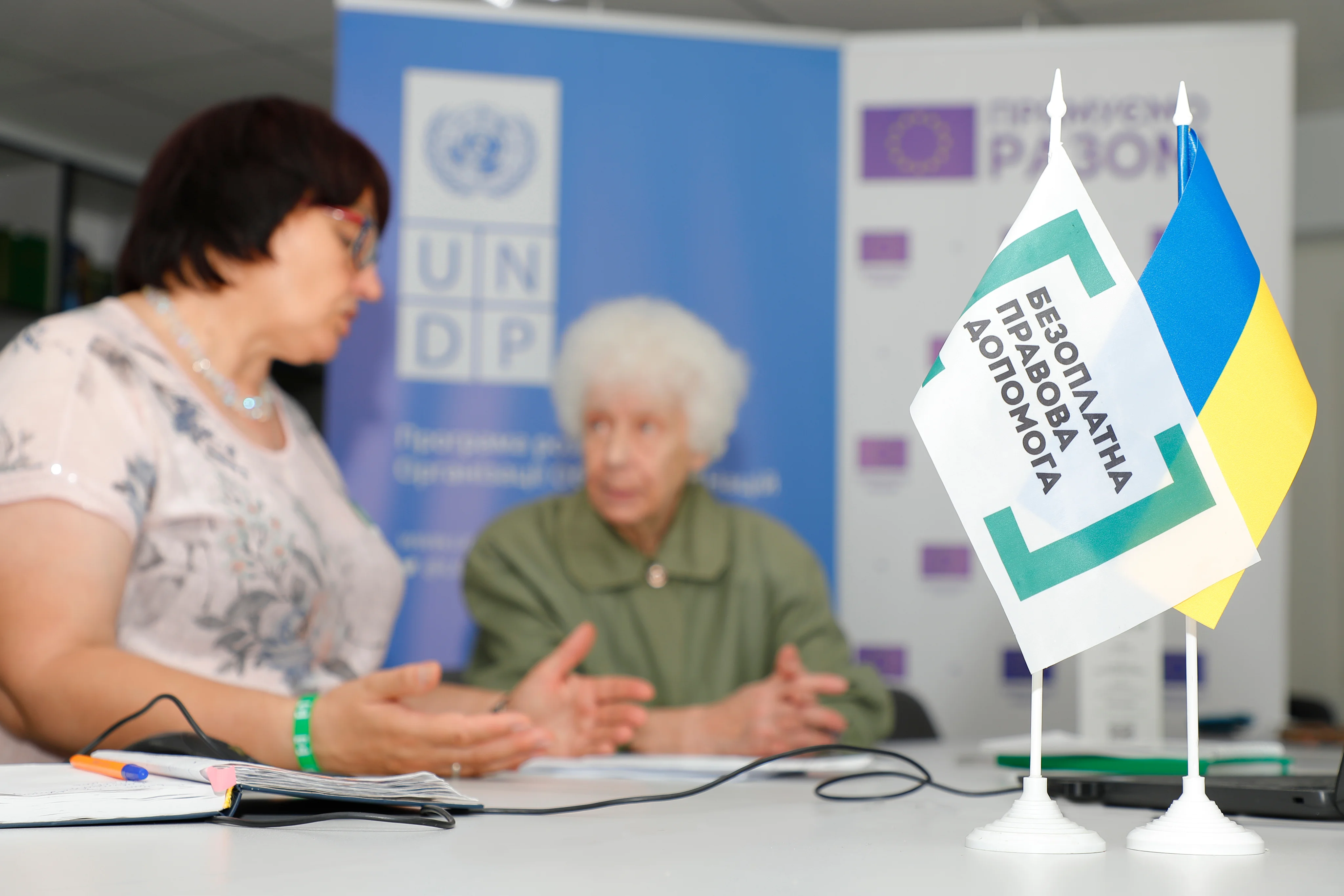
The delivery of free legal aid in Ukraine.
To enable FLAS to deliver high-quality legal services, UNDP strengthened the capacity of legal professionals through advanced training methodology. A pool of qualified internal trainers was established, ensuring continuous learning and skill development to address the complex legal needs of those impacted by the war. Sixty new FLAS trainers (42 women, 70 percent) and 422 lawyers and managers (352 women, 83.4 percent) were trained in critical areas, including communication with vulnerable groups and psychosocial support under martial law.
To further improve access to justice, UNDP supported law enforcement and forensic bodies in enhancing their investigative capabilities for human rights violations and crimes. This included investments in integration of victim-centred approaches and providing forensic technologies (such as rapid DNA identification), ensuring more effective prosecution of human rights violations.
UNDP’s continued support to the Ombudsperson’s Office, including through its Tripartite Partnership funded by the Government of Norway, bolstered its capacity to address human rights challenges. In 2024 the Ombudsperson’s Office processed over 123,000 human rights claims, one third more than last year. These efforts contributed to a positive evaluation of the Office by a recent Human Rights Progress Study. According to its results, almost half of surveyed human rights defenders noted improved performance by the Ombudsperson’s Office.
Furthermore, the regional network of the Ombudsperson’s Office expanded, improving human rights protection in remote war-affected areas and monitoring the human rights situation in 87 percent of formally established communities (hromadas). Over 5,900 individuals were consulted, and awareness raising initiatives reached more than 4,000 representatives of local authorities throughout the country.
Through the Global Programme for Strengthening the Rule of Law, Human Rights, Justice and Security for Sustainable Peace and Development, in partnership with the Ministry of Digital Transformation and the Ministry of Economic Development, UNDP advanced the Business and Human Rights (B+HR) agenda, promoting corporate responsibility and alignment with the UN Guiding Principles on Business and Human Rights. Over 1,000 business representatives, including over 700 women, were engaged through targeted capacity-development efforts. A total of 256 companies used the BHR self-assessment tool, with 97 receiving tailored guidance to enhance their human rights due diligence practices. Over 147,000 individuals were reached through digital awareness campaigns. UNDP also provided technical assistance to the Government of Ukraine in embedding BHR approach in key national recovery strategies.
Looking forward
In 2025, UNDP will further strengthen the institutional capacity of FLAS to ensure sustainable, high-quality legal aid for war-affected populations. Given the evolving legal needs of displaced persons, veterans and other vulnerable groups, tailored training and methodological support will remain essential. Additionally, institutionalizing best practices and developing FLAS’s internal training capacity will reinforce long-term sustainability.
UNDP will continue providing comprehensive support to the Ombudsperson’s Office, focusing on regional outreach, ensuring uninterrupted access to the Ombudsperson’s services.
To improve the capacity of national institutions to document and respond to human rights violations—including conflict-related sexual violence, destruction of infrastructure and civilian casualties—UNDP will support the development of standardized investigative protocols.