
Kyrgyz Republic
Countries & Territories


Key results
- The adoption of Kyrgyz Republic’s first National Action Plan on Business and Human Rights marked a landmark achievement, institutionalizing corporate due diligence, grievance mechanisms and human rights protections in economic governance.
- UNDP’s support through the Saving Lives Entity (SALIENT) initiative positioned Kyrgyzstan as a regional frontrunner in small arms and light weapons (SALW) control, with the launch of a digital Weapons Registry System and training of 14 government institutions on international arms control standards.
- With UNDP’s technical assistance, the Supreme Court adopted a resolution providing authoritative guidance on adjudicating environmental disputes, Kyrgyzstan’s first such measure, ensuring more consistent, transparent and legally sound decisions in environmental justice cases.
In 2024, the Kyrgyz Republic demonstrated notable progress in promoting social inclusion and strengthening human rights protections through legislative and policy reforms. In June, the National Parliament adopted amendments to the Criminal Procedure Code to ensure that persons with visual impediments can access judicial case materials in accessible formats, including Braille, large print and audio, in line with international standards on access to justice set forth in the Convention on the Rights of Persons with Disabilities.
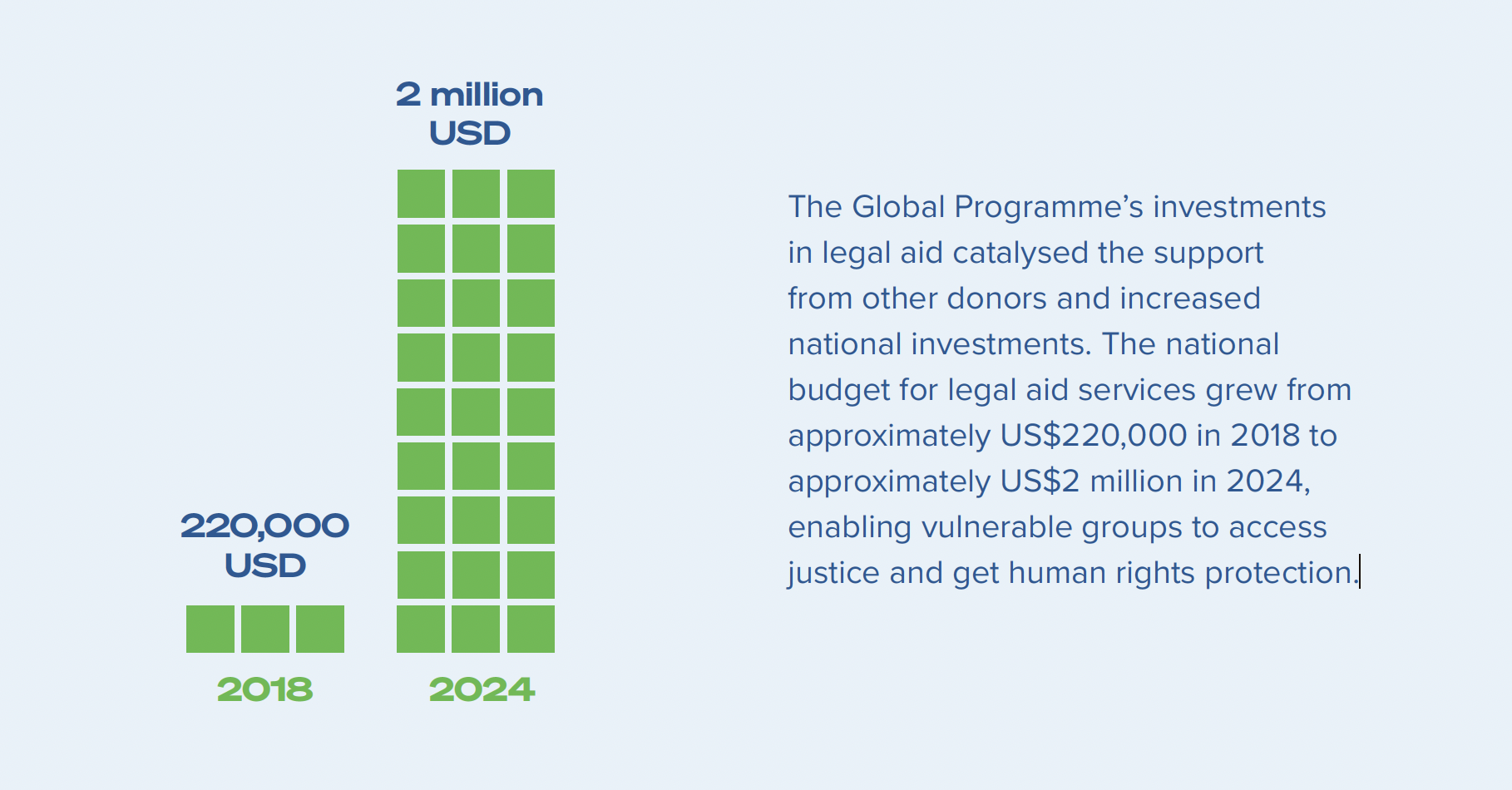
Furthermore, the Government approved a comprehensive national programme to strengthen the State-Guaranteed Legal Aid System for 2024–2028. National budget allocations for the system have significantly increased, from approximately US$220,000 in 2018 to US$2 million in 2024. This investment is expected to enhance access to justice for vulnerable and marginalized groups and contribute to the development of a more inclusive and rights-based justice system.
By the end of the year, 24 district Free Legal Aid bureaux and the national hotline had delivered 83,795 primary legal consultations and 16,092 instances of qualified legal assistance. These services reached women, rural communities and persons with disabilities through both stationary offices and mobile outreach via the “Bus of Solidarity” initiative, enhancing equitable access to justice across the country.
In 2024, UNDP, with support from the Government of Japan, significantly advanced the national Business and Human Rights (B+HR) agenda. Technical assistance to the Ministry of Economy and Commerce, as well as to the Ombudsperson’s Office, including peer-learning events, media advocacy and inter-agency consultations, led to the adoption of the country’s first National Action Plan on Business and Human Rights, marking a key milestone in aligning national policies with international human rights standards. Its implementation is expected to drive responsible investment, reduce rights violations and contribute to more inclusive and sustainable economic growth.
Under the Saving Lives Entity (SALIENT) project, the country established an inter-agency working group, conducted a comprehensive legislative review and submitted its national report under the UN Programme of Action (PoA) on small arms and light weapons (SALW). Fourteen government institutions were trained on international arms control standards. A major milestone was the pilot launch of the digital Weapons Registry System, developed in partnership with the Ministry of Internal Affairs and the Prosecutor General’s Office. Once scaled, the system will significantly improve the traceability of civilian firearms, enhancing public safety and crime prevention.
UNDP also contributed to a major advancement in environmental justice. In partnership with the General Prosecutor’s Office, the Ministry of Natural Resources and legal experts, UNDP facilitated a comprehensive judicial review on the adjudication of environmental cases. This process led to the adoption of a Supreme Court Plenum Resolution, which standardizes judicial practice in applying environmental legislation. The resolution is expected to enhance legal remedies for environmental harm and empower communities, civil society and local governments to hold polluters accountable, contributing directly to stronger environmental governance and sustainable development.
Looking forward
In 2025, UNDP will build on 2024 achievements by advancing gender equality, strengthening monitoring systems and supporting national rule of law and justice policies. This includes developing impact indicators and disaggregated data for evidence-based policymaking. Proven models, such as client-centred legal aid, environmental justice training and support for the National Action Plan on Business and Human Rights, will be scaled up. UNDP will also foster regional peer learning across Central Asia. Subject to funding, continued support will target disability rights, environmental justice and small arms control. These efforts aim to consolidate reforms, expand access to justice and embed inclusive, rights-based governance as a foundation for sustainable development in Kyrgyzstan and the region.