
Iraq
Countries & Territories


Key results
- UNDP interventions strengthened inter-agency coordination on environmental governance among the Ministry of Environment, the Ministry of Interior (MoI) and the Supreme Judicial Council, leading to the establishment of a formal working group and a joint enforcement protocol on environmental law.
- Increased awareness of environmental and climate justice among institutions led to enhanced capacity building, legislative reforms and community engagement in reporting environmental violations.
- The Iraqi police successfully assumed full security responsibilities in six governorates: Babel, Wasit, Najaf, Diwaniyah, Thi-Qar and Muthanna. This marked a milestone in the implementation of the Ministry of Interior’s strategy designed and operationalized with UNDP support.
Iraq is among the countries most vulnerable to climate change and environmental degradation, facing extreme temperatures, water scarcity, pollution and desertification – factors that disproportionately affect marginalized populations and contribute to displacement, health issues, economic hardship and national security risks. In response, and at the request of national institutions, UNDP, in partnership with the UN Human Rights Office and the UN Assistance Mission for Iraq, launched a programme to strengthen enforcement mechanisms for environmental protection and advance UNDP’s Environmental Justice Strategy. Based on a multidisciplinary mission in June 2023 that engaged stakeholders across sectors, the initiative addressed key challenges, including institutional fragmentation, outdated legal frameworks and weak enforcement. This project, supported through UNDP’s Global Programme for Strengthening the Rule of Law, Human Rights, Justice and Security for Sustainable Peace and Development marks a foundational step toward a broader environmental justice agenda in Iraq, integrating governance, rule of law and environmental efforts in a climate-vulnerable, post-conflict setting.
UNDP interventions significantly strengthened inter-agency coordination on environmental governance in Iraq, leading to the establishment of a formal working group between the Ministry of Environment (MoE), Ministry of Interior (MoI) and the Supreme Judicial Council. This collaboration resulted in a joint enforcement protocol on environmental law. In addition, a draft Memorandum of Understanding was designed outlining roles and responsibilities for field-level cooperation between the two ministries.
Awareness of environmental and climate justice increased notably among justice and law enforcement institutions, generating stronger interest in capacity building and collaborative enforcement of environmental regulations. This shift helped address a key gap – limited coordination among institutions responsible for environmental protection. In addition, the draft Law for the Protection and Improvement of the Environment was revised, incorporating stakeholder feedback from government, judiciary and parliament.
A major legal milestone was the completion of a comprehensive review of Iraq’s environmental and climate justice legal framework, aligning it with international environmental and human rights standards. The findings and recommendations were submitted to the MoE to guide future legislative reform. In parallel, institutional capacity was enhanced through the training of 23 environmental inspectors, including three women, and 23 environmental police officers on investigation procedures related to environmental violations.
The judiciary’s engagement was strengthened through targeted consultations involving 23 representatives (including four women) from the Supreme Judicial Council, MoE legal department and Kurdistan Region Government (KRG) judiciary. This led to concrete recommendations, including the proposal to establish specialized courts or designate judges for environmental cases. A separate consultation in the KRG identified regional-specific priorities and next steps for environmental governance.
The project applied a people-centred and rights-based approach by enabling community members to report environmental violations and involving civil society and local activists in consultations. Voices from 21 civil society actors in the KRG were documented to ensure grassroots perspectives informed institutional reforms. This inclusive approach fostered greater ownership.
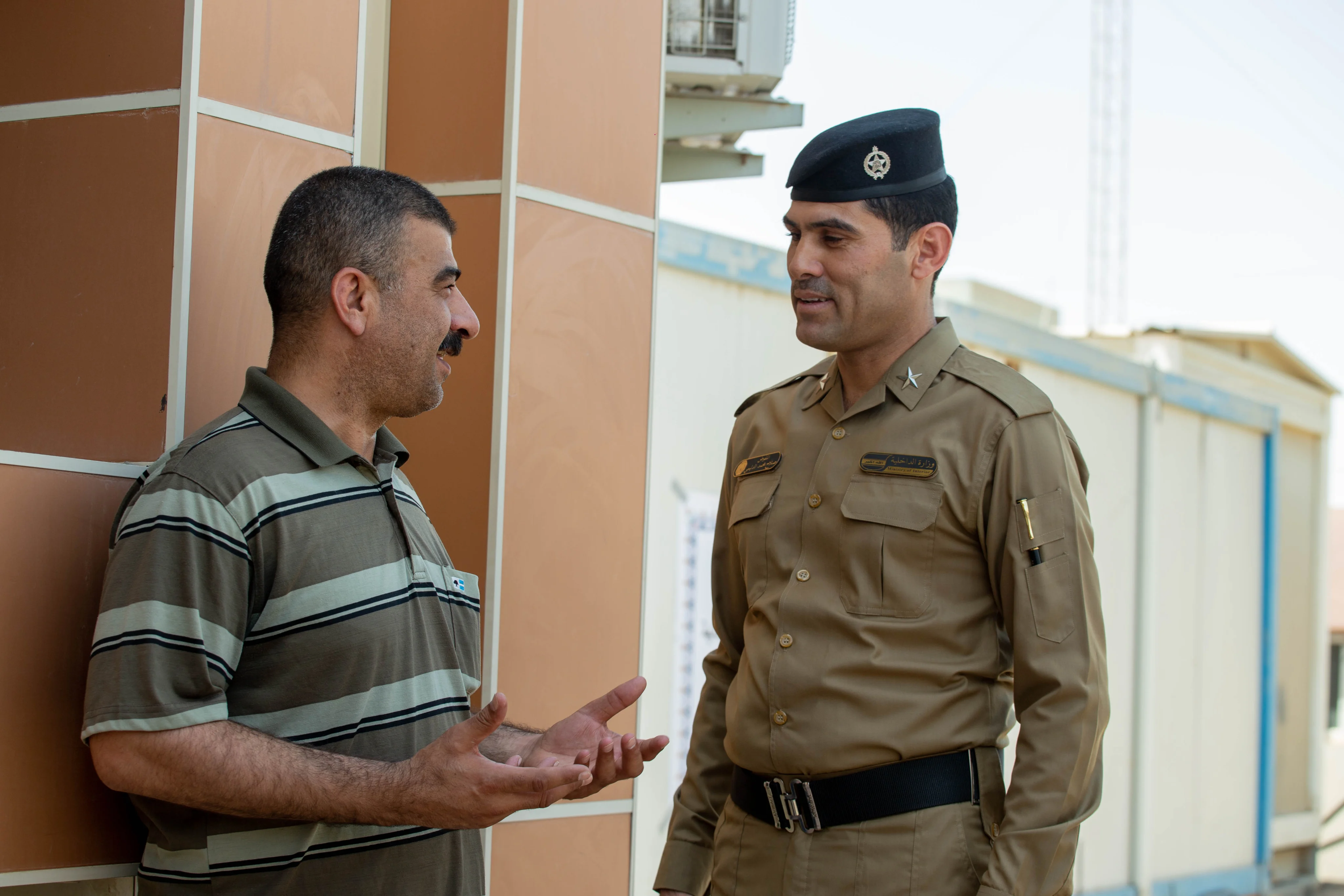
Open house days at the Model Police Stations in Iraq help to align police service delivery with community needs, fostering trust between the local population and the police force.
Overall, the project adopted a two-pronged strategy to advance the right to a healthy environment:
- enhancing institutional capacities and legal frameworks, and
- integrating civil society voices into policy dialogue. This comprehensive approach laid the groundwork for a broader environmental justice agenda in Iraq.
In parallel, UNDP in Iraq continued its engagement with national stakeholders to address critical gaps in the justice and security sectors made possible through the generous funding by the Government of Denmark. On a policy level, key strategies were adopted and operationalized with UNDP technical support, including the strategy of the Ministry of Interior and the Security Sector Reform Strategy, both guided by a people-centred approach. In addition, UNDP supported the development of Standard Operating Procedures (SOPs) in six core policing areas, ensuring alignment with international policing standards. These SOPs aim to standardize practices across Iraqi police forces, improve operational consistency and further embed the principles of rights-based policing. As a milestone in the strategy implementation, in 2024 the police successfully assumed full security responsibilities in six governorates: Babel, Wasit, Najaf, Diwaniyah, Thi-Qar and Muthanna.
As part of its commitment to fostering trust between communities and law enforcement, UNDP facilitated 16 open house days at the Model Police Stations (MPS) across five governorates. These events provide community members with a direct platform to engage with MPS Chiefs, fostering open and constructive discussions. These open house days have proven instrumental in shaping police service delivery to align with community needs, fostering trust between the local population and the police force.
Finally, in 2024, UNDP significantly enhanced the capacity and cooperation of stakeholders in financial crime investigations and anti-money laundering efforts. Through various workshops, training sessions and strategic initiatives, UNDP improved skills, knowledge and collaboration among national actors, including the judiciary and private sector. Key achievements included the development of training materials, the use of advanced software and the promotion of sustainable practices to ensure effective financial crime investigations and compliance with anti-money laundering requirements.
Looking forward
Looking ahead to 2025, the programme will focus on critical priorities, including climate change awareness, its integration into provincial security policies and incorporation of the fragility assessment results into policy frameworks.
Further priorities include strengthening policing capabilities through a people-centred approach and supporting the transition from military to civilian security leadership. Additionally, the establishment of a third learning and development hub and the expansion of the case management initiative to two more police stations will enhance transparency and modernize workflows. Finally, in collaboration with the MoI and justice sector stakeholders, UNDP will continue its targeted interventions to address systemic barriers for women in policing.