
Global focal point for the rule of law
Countries & Territories
Overview
In 2024, the Global Focal Point for the Rule of Law (GFP) continued to provide expertise and catalytic funding for integrated joint approaches across the United Nations in the rule of law area. Co-chaired by UNDP and the UN Department of Peace Operations (DPO), GFP reinforces a One-UN approach at the global and national levels to reduce violence, protect human rights and restore justice and security for people affected by crisis and conflict.
Since its operationalization in 2012, the GFP has provided joint rule of law support to more than 40 countries and territories and has deployed 179 experts to strengthen and/or establish transparent, accountable and inclusive justice and security institutions, including in collaboration with the UN Standing Police Capacity and the UN Justice and Corrections Standing Capacity.
GFP catalytic effect in justice and security programming
The 2024 Secretary-General's Report on Peacebuilding and Sustaining Peace highlights the essential role of the rule of law in preventing conflicts and maintaining peace and security. It stresses that the rule of law tackles the fundamental causes of grievances and violence, providing a viable solution to break the cycles of conflict and crisis. By promoting justice, accountability and fair governance, the rule of law helps build resilient societies and ensure lasting peace.
To uphold the rule of law amidst crisis and fragility, through UNDP’s Global Programme for Strengthening the Rule of Law, Human Rights, Justice and Security for Sustainable Peace and Development, the GFP provided catalytic funding for joint rule of law programming in the Central African Republic (CAR), the Democratic Republic of the Congo (DRC), Haiti, Liberia, Libya, Mali and Somalia.
In 2024, UNDP and the UN Human Rights Office, under the coordination of the UN Resident Coordinator’s Office, initiated a joint rule of law engagement in Liberia to support the national partners in establishing a specialized War and Economic Crimes Court to ensure accountability and improve human rights protection.
In early 2024, the GFP coordinated and supported a UNDP-DPO joint mission to CAR to provide support for the joint programme between the UNDP Country Office and the UN Multidimensional Integrated Stabilization Mission in the Central African Republic (MINUSCA) and to engage with national partners, in particular the Special Criminal Court and other rule of law and justice mechanisms. Last year, the Special Criminal Court issued its second judgment, convicting four individuals for crimes against humanity and war crimes (the judgment is currently under appeal). In another case (Paoua massacre), nine direct victims (including five survivors of sexual violence) and 32 families affected by the attack on the villages, received financial reparations, marking a historic milestone in the fight against impunity in the country.
In DRC, reducing prison overcrowding was one the GFP priorities. To expedite case consideration, the programme organized mobile court hearings in North Kivu, Kasaï-Central and Tanganyika. Over 100 cases were considered, including those related to war crimes, sexual violence and child conscription. Over 100 detainees were acquitted and released. Fair trial guarantees were observed, with lawyers providing legal assistance to all the defendants.
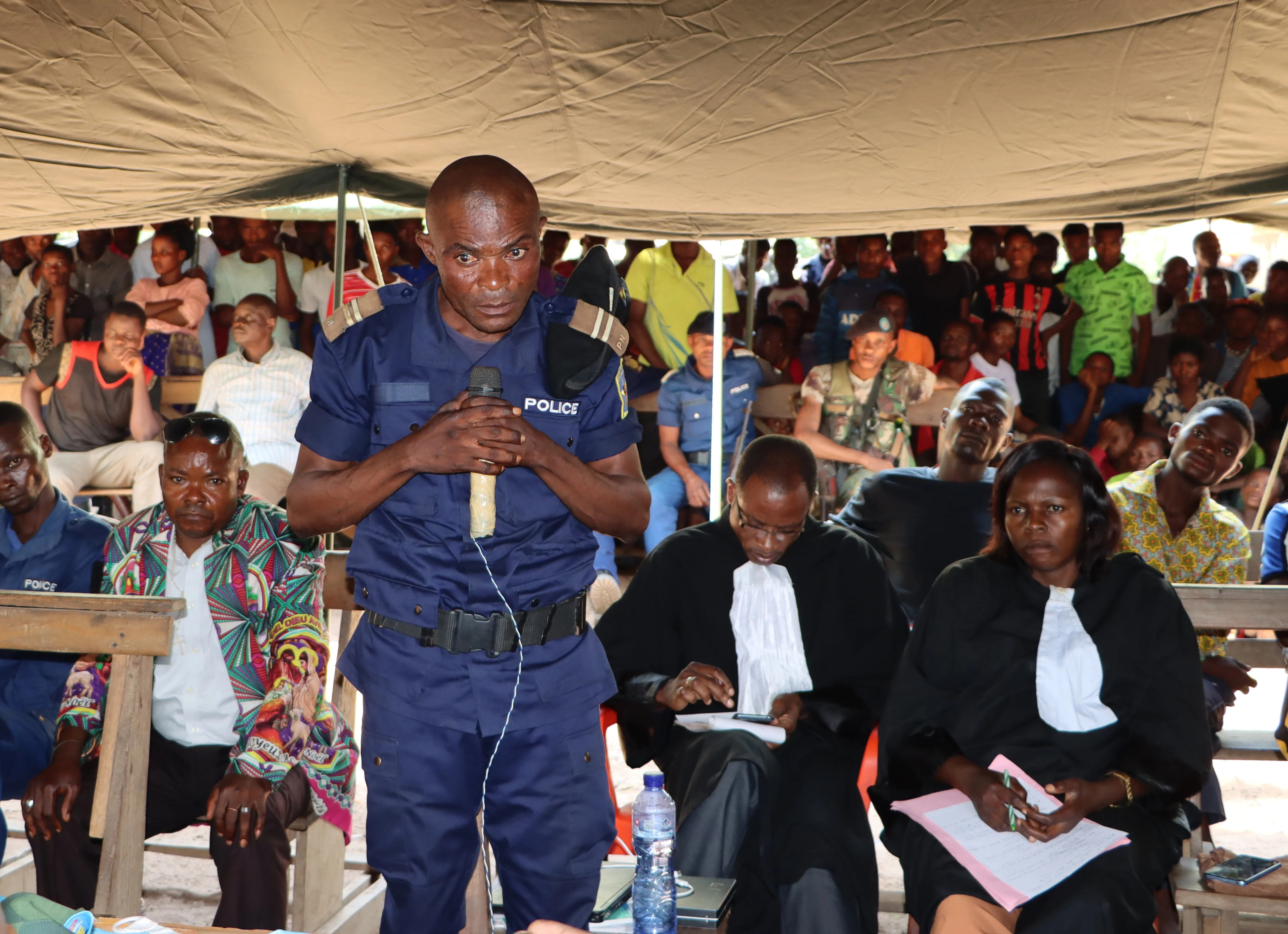
Mobile court hearing of the Military Court in Kasai Central, DRC.
In 2024, the GFP advanced inter-agency coordination and collaboration across the UN system, convening nine strategic information exchanges on rule of law, security and human rights, including two focused on country-specific contexts. To broaden its engagement, the GFP core team introduced Assistant Secretary-General level briefings for Resident Coordinators, provided strategic updates to the Group of Friends for the Rule of Law and contributed to high-level discussions at the Annual Academic Conference on Africa. In parallel, the GFP Working Group on Gender Justice remained active, further advancing the Women, Peace and Security agenda across its programming and partnerships. To encourage the deployment of women corrections officers in UN peace operations, the GFP contributed to the organization of the UN Trailblazer Award ceremony, building on the 2023 GFP-supported CORE Gender Parity Initiative. This award honors women justice and corrections officers who challenge gender stereotypes and barriers.
Looking forward
The GFP will continue to serve as a single-entry point for rule of law assistance, enhancing effectiveness and reducing duplication among UN agencies. It will strengthen links with senior UN leadership to ensure coordinated interventions and promote joint programming. Additionally, GFP will advocate for broader UN involvement in peace operations and peacebuilding dialogues, focusing on accountability and practical action. The GFP will also participate in the strategic engagements on the Peace Building Architecture Review.