

Regional overview
Countries & Territories
Europe and Central Asia (ECA) remains confronted with significant challenges and a prolonged crisis. The rule of law and human rights are in steady decline, marked by deepening division and polarization. In several countries and territories, civic space is severely restricted. Across much of the region, peace and security are deteriorating. The ongoing war in Ukraine further undermines regional stability. Meanwhile, millions of displaced people still face serious gaps in access to effective legal assistance. Systemic rights violations by public and private entities, including companies involved in extracting transitional minerals and their environmental impact, remain a cause for concern. On a positive note, the start of the European Union (EU) accession negotiations with Bosnia and Herzegovina, Moldova and Ukraine, as well as granting candidate status to Georgia, created favourable conditions for accelerating rule of law reforms. However, there have been setbacks in some cases, where the adoption of restrictive legislation has resulted in political crises.
In this challenging context, UNDP up-scaled its support, providing effective and accessible rule of law services, including through the Global Programme for Strengthening the Rule of Law, Human Rights, Justice and Security for Sustainable Peace and Development (the Global Programme).
Environmental justice
UNDP continued supporting UNDP Offices in expanding their environmental justice programming in Bosnia and Herzegovina, Georgia, Kazakhstan, Kyrgyzstan, North Macedonia and also Kosovo. In Georgia, for example, UNDP completed an advocacy campaign promoting the right to a healthy environment with an online reach exceeding 300,000 people. UNDP Georgia also supported the development of a specialized training module on environmental justice for the High School of Justice to be incorporated into the judicial training curriculum. To advance the environmental justice agenda and offer guidance, UNDP delivered a side event on environmental crimes in the framework of the Ninth Criminal Justice Forum for Central Asia in Astana, Kazakhstan.
Business and Human Rights (B+HR)
UNDP achieved important milestones in the area of business and human rights in the ECA region in 2024. In Kazakhstan, UNDP provided technical expertise to the government-led working group to support the development of policy recommendations, and the Kyrgyz Government adopted the National Action Plan on Business and Human Rights, the first policy document of its kind in the region with a political commitment from the authorities to effective implementation. Azerbaijan and Serbia had their first baseline assessments on B+HR. The fourth regional event on business and human rights in Budva, Montenegro, emphasized the importance of strategic regional work in the context of the EU's new environmental and human rights due diligence obligations.
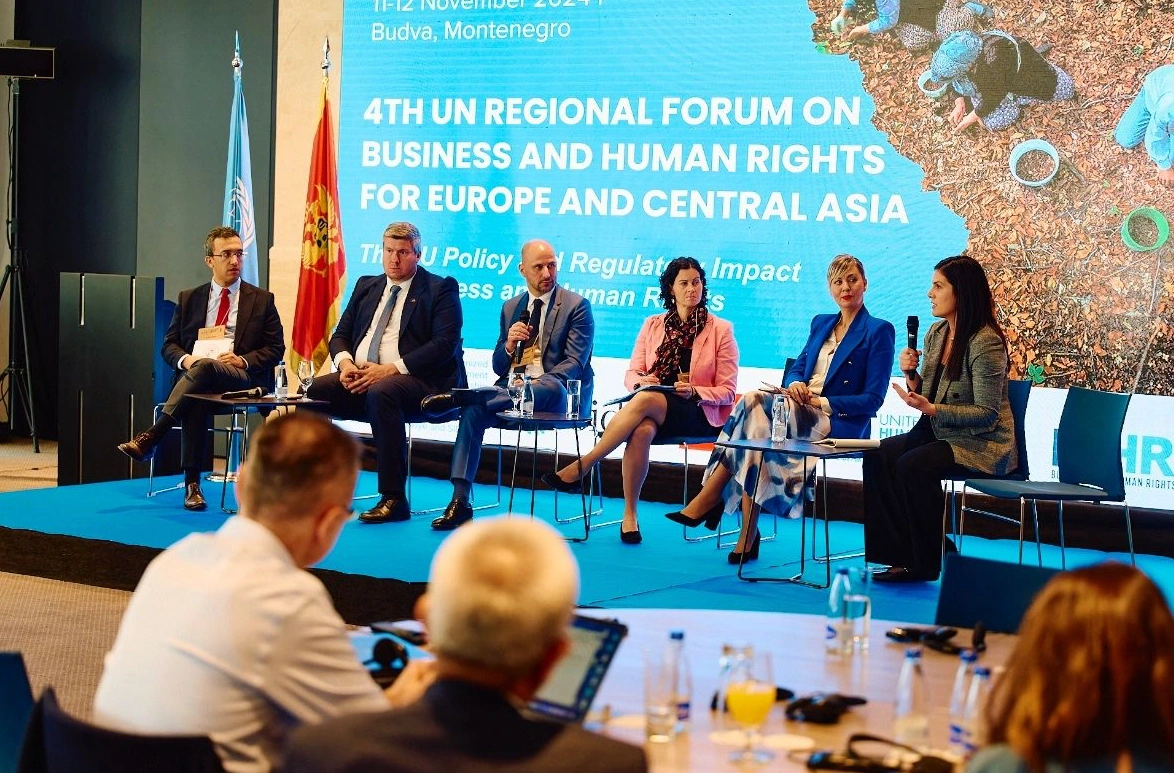
The 4th regional event on business and human rights in Budva, Montenegro
Support to national human rights institutions (NHRIs)
To reinforce the institutional foundations for upholding human rights and the rule of law, UNDP, in partnership with the Office of the UN High Commissioner for Human Rights (OHCHR) and the European Network of NHRIs (ENNHRI), assisted the NHRIs in Georgia, Moldova, North Macedonia and Ukraine. NHRIs strengthened their capacities in the areas of strategic planning, the right to a healthy environment and climate justice, and became better equipped to provide effective assistance to people. For example, in Georgia, the NHRI was supported in promoting the right to safe water and enhancing access to it.
Transitional justice in the Western Balkans
In the Western Balkans, UNDP continued its cooperation with the EU to promote accountability for war crimes, improve mechanisms to support victims and promote cross-border cooperation and reconciliation. Montenegro adopted its first four-year war crimes prosecution strategy. In Bosnia and Herzegovina, Montenegro, Serbia and also in Kosovo, more than 230 justice professionals received training on war crimes investigations. Through a network of local civil society organizations (CSOs) supported by UNDP, direct psychosocial, medical and economic assistance has been provided to over 2,000 victims of war crimes.
The following examples highlight the results achieved with direct support from UNDP’s Global Programme. Additional achievements for each context can be found in the Impact section of this report.
In Albania, UNDP supported the Ministry of Justice (MoJ) in the sustainable delivery of free legal aid (FLA) services. There are 20 FLA centres in Albania, 12 of which were set up with UNDP support and are now fully funded by the state. Over 2,400 people, including 1,441 women, received free legal aid. A total of 1,751 individuals were informed about their rights and gained skills to navigate digital platforms for legal aid. To further improve access to information about e-government services, UNDP supported civil society-led dialogue between marginalized communities and local public service providers. By supporting vulnerable groups, including low-income individuals, gender-based violence survivors, persons with disabilities, as well as Roma and Egyptian communities, UNDP facilitates access to legal aid and public services, fostering a greater trust in the institutions.
In Moldova, UNDP, in partnership with civil society, has helped 5,156 people (3,670 women, 1,486 men) access justice through legal counselling, assistance and information. Nearly 3,600 Ukrainian refugees (2,653 women, 947 men) have received support navigating Moldova’s temporary protection system. UNDP’s technical and digital assistance has enabled innovative solutions—from a multilingual chatbot informing refugees of their rights to a tele-assistance platform linking detainees with legal aid. Five UNDP-supported mobile teams have also reached over 1,000 women and girls with grievance redress and support services.
In North Macedonia, UNDP supported the integration of environmental justice in the first-ever National Development Strategy 2024-2044, a key document outlining the country's long-term development priorities and ensuring the country meets its sustainable development targets. A comprehensive baseline assessment on access to environmental justice was drafted. Public awareness among official decision-makers was raised. Over 280 people took part in various workshops, training sessions, study visits and other events to improve understanding of environmental justice issues among local stakeholders. Furthermore, the project “Increasing the Role of the Ombudsman in Environmental Justice” explored innovative approaches to upholding environmental justice across the region. UNDP, in collaboration with OHCHR and the European Network of NHRIs, improved NHRI capabilities to monitor and address environmental rights violations. The project also helped advance the regional network of the NHRIs in the area of environment and human rights. A mentorship programme was implemented to enable Ombudsperson staff to handle environmental justice cases more effectively. Partnerships with CSOs were formalized to improve cooperation in the prosecution of environmental justice violations.
Looking forward
UNDP will promote rights-based approaches to just transition, digitalization and inclusive economic models that are fairer to people and the planet. It will support targeted sub-regional initiatives on environmental justice and responsible business conduct, including in the extractives sector, in line with the UN Guiding Principles on Business and Human Rights and EU sustainability regulations. These efforts will include advancing environmental justice and integrating human rights impact assessments in emerging technologies such as artificial intelligence (AI).
Strategic rule of law programming will be implemented to support EU accession processes, where they align with the SDGs, in Moldova, Ukraine and the Western Balkans, and promote access to justice in Georgia.
UNDP will also seek to strengthen regional partnerships to address the engagement needs of NHRIs on conflict prevention, environmental justice, displacement and securitization.
-
References to Kosovo shall be understood to be in the context of Security Council Resolution 1244 (1999).