
Regional overview
Countries & Territories
The Arab States region experienced continued upheaval in 2024. The Gaza war entered its second year, pulling Lebanon further into the conflict and exacerbating regional instability. Meanwhile, Houthis in Yemen increased their attacks in the Red Sea in response to the war in Gaza. In Sudan, conflict spread to new areas, displacing millions of civilians, while tensions in and around Somalia continued to rise.
Political developments across the region presented both challenges and opportunities. In Syria, the end of more than five decades of authoritarian rule has given rise to much hope, alongside demands for justice and accountability. The year 2024 also witnessed elections in Algeria, Jordan, Kuwait and Tunisia. However, civic space across the region remained constrained or entirely closed, continuing a troubling trend of decline. Whether these political shifts will lead to meaningful advancements in the rule of law and human rights remains uncertain.
Despite these challenges, UNDP stayed and delivered. Technical and financial assistance from the Global Programme for Strengthening the Rule of Law, Human Rights, Justice and Security for Sustainable Peace and Development (the Global Programme) has enhanced the delivery of efficient and accessible rule of law services to vulnerable populations.
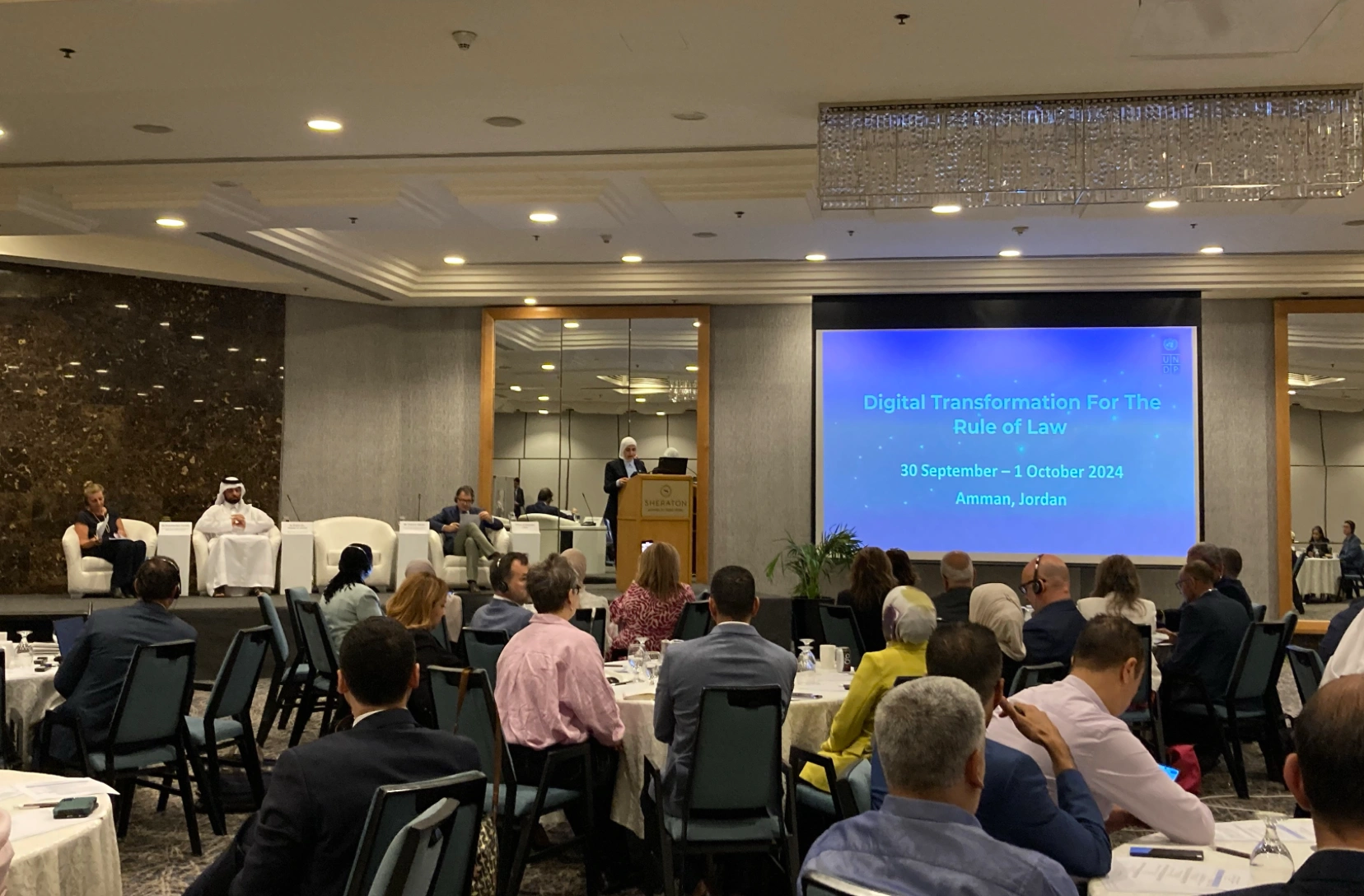
A workshop on Digital Transformation for the Rule of Law.
Access to justice
UNDP continued to support people-centred access to justice through country-level activities in Egypt, Lebanon, Libya, Tunisia, and beyond. In the State of Palestine, the Sawasya III joint programme provided legal aid to over 13,000 individuals, of whom 88 percent were women. Targeted legal awareness sessions reached over 21,000 individuals, including 16,433 women, equipping them with critical knowledge about legal rights and available remedies. In Yemen, UNDP and UNICEF provided legal assistance to women detainees and their children as well as expanded woman- and child-friendly spaces in justice and security institutions. In Djibouti, UNDP supported the development of a Statistical Information System to enhance the reliability of access to justice data. To expand access to environmental justice, UNDP Iraq raised awareness of the right to a healthy environment among the justice and law enforcement institutions.
Digital justice
Human rights-based digitalization enhances the efficiency and transparency of justice administration. In response to the growing interest in digital justice, the Moroccan institutions, with support from UNDP, hosted an international e-justice conference, bringing together representatives from the Arab States and Africa. Building on this momentum, UNDP organized a regional exchange on digital transformation for the rule of law, showcasing digital solutions for justice, human rights and security. Through its Global Programme, UNDP provided technical assistance to identify and implement digital tools, including in Bahrain, Djibouti, Egypt, Libya and Palestine.
In the State of Palestine, the UNDP-supported Mizan court management system was awarded second place in the 2024 SDG Digital Game Changers Award under the “Peace” category for its impact on justice services. In 2024 alone, the electronic court management system served 164,661 beneficiaries, including judges, prosecutors, lawyers, court staff and the public.
Business and Human Rights
In October 2024, UNDP hosted the Inaugural Dialogue on Business and Human Rights in the Arab States Region in Doha, in collaboration with the Qatar National Human Rights Commission, the Arab Network of National Human Rights Institutions and UN agencies. Attended by over 300 stakeholders, the event focused on addressing challenges and promoting responsible business practices through the UN Guiding Principles on Business and Human Rights (UNGPs). The dialogue raised awareness, established a network of engaged parties and culminated in the adoption of the Doha Declaration.
With support from the Global Programme, a regional Business and Human Rights strategy was developed to enable programming across diverse political and economic contexts. In line with the proposed strategy, the Global Programme provided technical assistance to the National Human Rights Institutions (NHRIs) in Bahrain and Djibouti, focusing on the practical implementation of the UNGPs.
Strengthening National Human Rights Systems
Through the Tri-Partite Partnership with the UN Human Rights Office (OHCHR) and the Global Alliance of National Human Rights Institutions (GANHRI), UNDP launched a new project in Jordan to strengthen the capacities of the National Centre for Human Rights in alignment with the Paris Principles. Additionally, UNDP collaborated with the Arab Network for National Human Rights Institutions to facilitate several knowledge-sharing events, including the above-mentioned Regional Dialogue on Business and Human Rights and a regional gathering on the role of NHRIs in planning and monitoring the implementation of national visions.
Looking forward
In 2025, UNDP will continue prioritizing support in crisis and conflict settings to sustain rule of law, security and human rights initiatives. This will involve developing a crisis response package based on the lessons learned from the ongoing crises. UNDP will also continue advancing digital transformation in the rule of law sector with the introduction of a Digital Readiness Assessment Tool and a comprehensive offer on e-justice. Furthermore, UNDP will focus on strengthening the rule of law and justice programming as a driver of economic development, particularly expanding efforts on civil justice and Business and Human Rights. Lastly, UNDP will enhance its work on environmental justice within the broader climate change agenda in the region.