

State of Palestine
Countries & Territories


Key results
- The UN joint programme Sawasya III improved access to justice for vulnerable communities across Palestine. Over 13,500 Palestinians, including 11,182 women, received legal aid and psychosocial support. This support allowed them to claim rights and seek protection through existing justice systems. Mediation services helped 396 women resolve disputes outside of court, and 1,164 juvenile cases benefitted from mediation services.
- The Mizan court management system has emerged as a model of innovation in justice sector reform. Amid widespread movement restrictions, Mizan enabled remote case management and facilitated judicial proceedings for 164,661 users, including judges, prosecutors and litigants. Mizan's success was recognized internationally when it secured second place in the 2024 SDG Digital GameChangers Award under the “Peace” category.
- In 2024, Sawasya III deepened its partnerships with civil society, working with 59 civil society organizations (CSOs) and academic institutions across the West Bank, including East Jerusalem and Gaza. Of these, 30 CSOs were directly contracted to deliver legal aid, psychosocial support and legal awareness services. These partnerships played a critical role in ensuring that services were context-sensitive and accessible to those most in need, particularly women and children, reinforcing inclusive justice at the local level.
In 2024, the State of Palestine experienced severe challenges that significantly hindered access to justice and complicated efforts to strengthen the rule of law. In the West Bank, heightened military operations, rising settler violence and restrictive movement policies disrupted daily life, preventing many from reaching courts, legal assistance and protective services. Vulnerable groups, including women and children, were particularly affected, as their avenues for support became increasingly limited.
Meanwhile, the conflict in Gaza triggered a deepening humanitarian crisis and resulted in the widespread destruction of judicial infrastructure, police stations and detention centres. The loss of these critical facilities weakened the provision of essential legal protections and magnified existing inequalities. Women faced especially harsh conditions, with many experiencing violence and losing vital legal or civil documentation, further undermining their rights and access to humanitarian aid. Children also endured heightened risks of exploitation, abuse and psychological trauma due to the damage sustained by protective services and educational institutions. As a whole, these developments underscored the urgent need for comprehensive interventions to restore the rule of law and safeguard the most vulnerable members of Palestinian society.
To reinforce equal access to justice, the Sawasya III, a five-year joint programme implemented by UNDP, UN Women and UNICEF, focused on assisting to create a protective, inclusive and responsive justice system. To uphold human rights and promote gender equality, the Sawasya III tailored its interventions to the specific needs of different regions, including Area C, East Jerusalem, Hebron 2 in the West Bank and the Gaza Strip.
To align its efforts with national legal frameworks and contribute to the capacity development of local institutions, UNDP partnered with leading judicial institutions such as the Ministry of Justice, the High Judicial Council, the Attorney General’s Office, the Supreme Judge Department and the Palestinian Judicial Institute. Additionally, a wide network of CSOs and academic institutions were engaged.
In 2024, Sawasya III supported meaningful progress in two key areas of the justice sector: expanding legal aid services and advancing digital reform within the justice system. Through the programme, 13,517 Palestinians, including 11,182 women, gained access to legal aid and psychosocial support, significantly strengthening their capacity to claim rights and engage with justice mechanisms. Targeted legal awareness sessions reached over 21,000 individuals, including 16,433 women, equipping them with critical knowledge about legal rights and available remedies. Additionally, mediation services supported 396 women in resolving disputes outside the courtroom, while 1,164 juvenile cases benefitted from mediation services. These efforts were instrumental in empowering vulnerable groups, especially women and children, to seek justice and protection.
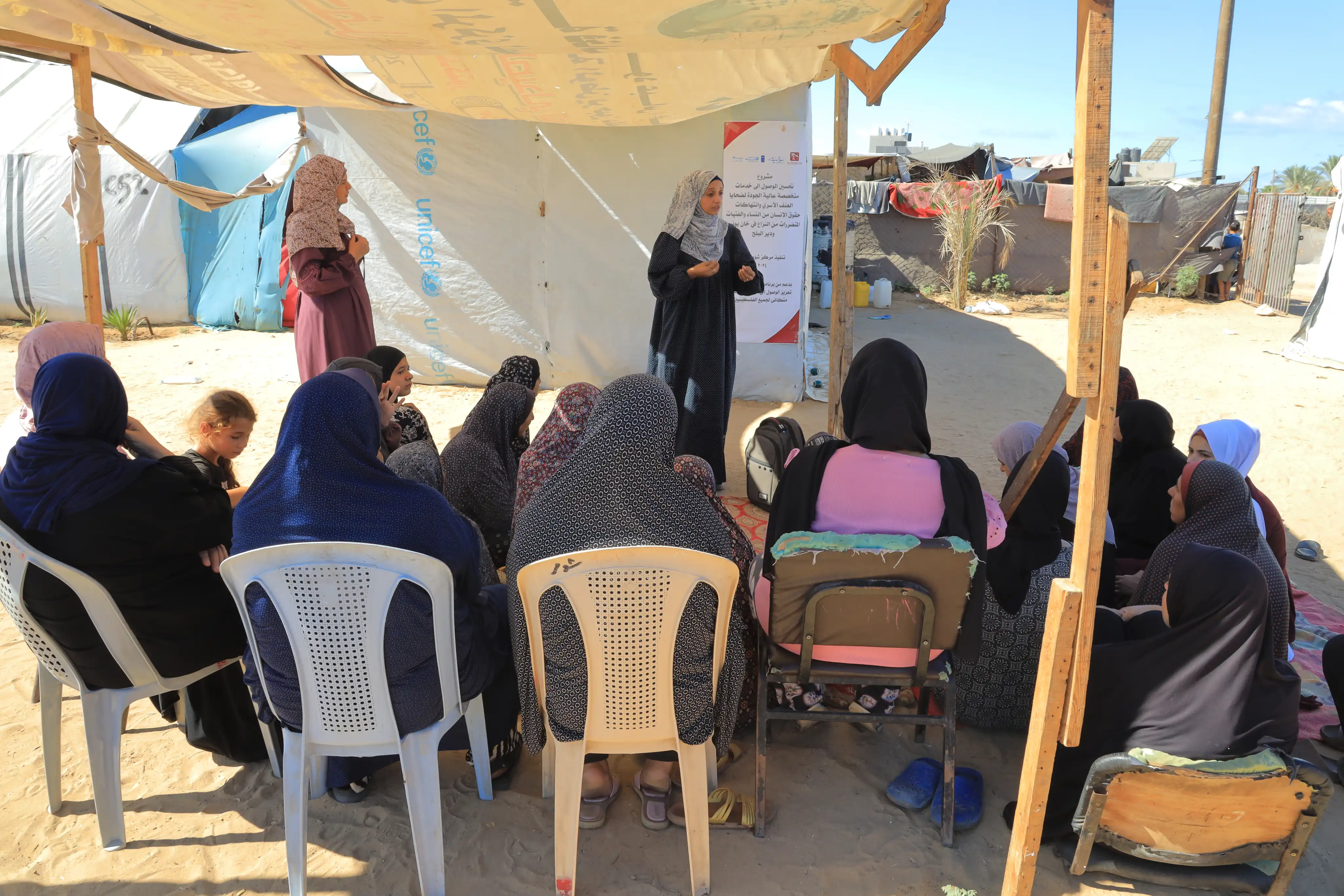
Legal awareness session in the Middle Area, Gaza Strip.
Simultaneously, the Mizan court management system continued to lead digital justice reform. In a context marked by movement restrictions that often limit physical access to courts, Mizan enabled remote case management and judicial proceedings for 164,661 users, including judges, prosecutors and litigants. By digitizing 86,200 legal documents, the system enhanced efficiency, transparency and accessibility across the justice sector. Mizan’s transformative impact received international recognition when it was awarded second place in the 2024 SDG Digital GameChangers Award under the “Peace” category, with special acknowledgement for its contributions to SDG 16 and SDG 5. Mizan demonstrated that digital tools, when contextually adapted, can strengthen institutional resilience and support inclusive justice delivery.
Looking forward
With a cessation of hostilities agreement in place and largely holding, the installation of a reform-oriented government and key appointments to critical posts, including the Judicial Inspection Authority and the Director General of the ISF, the foundations are being laid for transformational change in Lebanon. These developments present a unique window for UNDP to scale up its comprehensive efforts to strengthen the independence, effectiveness and accessibility of rule of law institutions. At this pivotal juncture, such engagement is vital to restoring people’s confidence in the State and advancing the broader agenda of peace and stability.
-
Mizan II, an integrated digital court management system, was developed by the High Judicial Council of the State of Palestine with UNDP support. Mizan enhanced the justice delivery, increased efficiency and transparency of the judicial system.