

Guatemala
Countries & Territories


Key results
- UNDP and partners improved access to people-centred justice services for young people, women and Indigenous communities. Youth was enabled to challenge structural power dynamics that often excluded them from justice processes. National capacities were strengthened to advocate for the inclusion of Maya youth in justice delivery.
- Indigenous youth was empowered to become community tourist guides to promote historical memory and gain economic autonomy. "Rabinal Travel," a for-profit civil society organization was established along with the three coordination spaces for community tourist guides.
- In collaboration with the Supreme Electoral Tribunal, UNDP designed a training curriculum, which was adopted by the Tribunal, focusing on leadership, gender and communication skills, particularly empowering Indigenous women.
In Guatemala, the beginning of 2024 was marked by the resolution of post-election turbulence. In January, both the President and the Vice-President of the Republic were sworn in, and the authorities of the Judicial Branch were selected, including the magistrates for the Supreme Court of Justice and the Courts of Appeals. UNDP re-established strong institutional connections with the Judicial Branch, aiming to enhance the capacity of people-centred justice services for youth, women and Indigenous communities.
The project Maya Youth Promoters Of Peace in Verapaces and Quiché supported through UNDP’s Global Programme for Strengthening the Rule of Law, Human Rights, Justice and Security for Sustainable Peace and Development (the Global Programme) focused on (1) access to justice, (2) community tourism with a focus on historical memory and (3) the development and strengthening of capacities regarding civic and political rights.
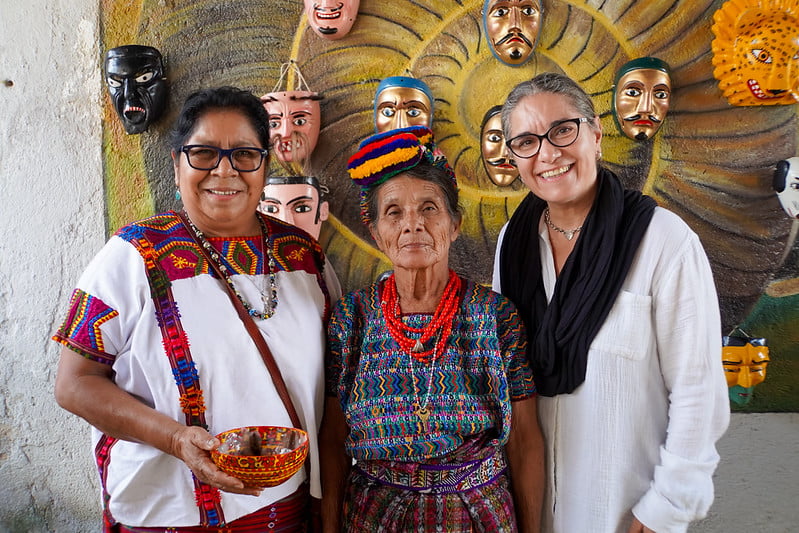
In Guatemala, Indigenous women and youth were empowered to become community tourist guides to promote historical memory and gain economic autonomy.
In total, 325 women benefitted from the project, representing 68 percent of the participants, with 70 percent from Indigenous communities.
The involvement of governmental institutions and civil society was essential. UNDP strengthened its alliances with the Secretariat of Indigenous Peoples (SPI) of the Judicial Branch, the Technical Institute for Training and Productivity (INTECAP), the Guatemalan Tourism Institute (INGUAT) and Supreme Electoral Tribunal (TSE), as well as with the municipal mayor of Rabinal and the municipal youth offices of Salama and Cobán.
1. Improved access to people-centred justice services for young people, women and Indigenous communities
In partnership with the SPI and the Secretariat for Judicial Strengthening and Cooperation (SFJC) of the Judicial Body, UNDP organized four intergenerational meetings for youth from Quiché and Alta Verapaz and authorities from both the ordinary and Maya justice systems. In this dialogue space, youth could challenge structural power dynamics that often exclude them from justice processes.
“Thank you for explaining Maya justice to us. […] We were able to talk with the traditional authorities; they listened to us, heard our questions and responded. It felt good to be heard and to have our doubts clarified.” – Young woman, the workshop participant.
“I really liked this because here in Cobán, Alta Verapaz we need to improve justice, and there are many young people who don't have opportunities. […] I hope we can continue with more learning. The youth in Cobán need to know what justice is.” – Young man, the workshop participant.
Five preparatory sessions were held to assess needs, apply design thinking and develop diagnostics on justice access barriers for Indigenous youth. The processes led to significant shifts in institutional attitudes and strengthened the capacity of the SPI to advocate for the inclusion of Maya youth in justice delivery, promoting legal pluralism and empowering vulnerable groups to assert their rights.
2. Strengthened youth capacities in historical memory, community tourism, social entrepreneurship, leadership and organizational participation
"Rabinal Travel," a for-profit civil society organization (CSO) was established. To enable young guides to promote community tourism with a focus on historical memory, UNDP strengthened the technical skills of 80 Achí youth (70 percent women) from the municipalities of Rabinal, Cubulco and San Miguel Chicaj in Baja Verapaz. Three coordination spaces for community tourist guides were created with INGUAT, the Historical Center Riij Ib’oy Río Negro and the Municipality of Rabinal.
The project had a catalytic effect as it secured continued support through a low-value grant to the Association for the Integral Development of Victims of Violence in the Verapaces Maya Achí (ADIVIMA), ensuring further development of the tourism initiative. The project also ensured continued capacity-building for youth through technical courses funded by the Catalan Agency for Development Cooperation (ACCD). This milestone reinforced economic empowerment and autonomy of the Indigenous youth.
3. Strengthened youth advocacy skills and political training
In collaboration with the Supreme Electoral Tribunal, this initiative included leadership training and strategic events, such as a Youth Building and Influencing fair and departmental gatherings in Alta and Baja Verapaz, which promoted youth civic engagement and collaboration with local authorities.
The initiative offered a comprehensive training curriculum, which was adopted by the Supreme Electoral Tribunal, and focused on leadership, gender and communication skills, particularly empowering Indigenous women. It facilitated the co-creation of advocacy strategies, strengthened youth networks and supported youth involvement in local governance.
The project expanded to include Quetzaltenango and Sololá, allowing for a broader impact in Indigenous communities and fostering skills transfer to municipal officials. In total, 237 young people participated in the leadership school, with 62 percent from Indigenous backgrounds.
Looking forward
By 2025, through a pilot initiative in El Quiché, efforts will be made to establish strategic coordination between the Maya justice system and the ordinary justice system to provide comprehensive attention to cases of violence against women. This initiative will focus on promoting coordinated case management with a gender perspective and cultural relevance; identifying and systematizing best practices to improve access to justice for women and Indigenous women from a plural justice perspective; strengthening the capacities of justice system actors; and fostering women's participation through dialogue and proposal spaces with local civil society organizations.