

Kenya
Countries & Territories


Key results
- The E-Judiciary Mobile Application is set to transform access to justice in Kenya. This potential is directly linked to the longstanding physical and financial barriers that have prevented marginalized communities and small business owners, including women, from fully accessing the judicial system. By offering a user-friendly platform for e-filing and case tracking, the application simplifies the judicial process and improves efficiency and accountability.
- UNDP supported the two civil society organizations (CSOs) in Mombasa County (Kituo Cha Sheria and Sisters for Justice) in addressing barriers that hinder women traders' access to justice. This was achieved through nine strategic engagement forums with women-based and women-led organizations and by creating a dedicated platform for women traders to openly discuss the obstacles they face in accessing justice and how Small Claims Courts (SCCs) can help overcome these challenges.
- Other interventions that were designed to raise awareness and deepen public understanding of the SCCs included legal aid clinics, community dialogue forums and capacity-building workshops, which in total, reached almost 900 individuals, half of them women. In addition, eight radio talk shows, which reached nearly 5.3 million listeners were conducted.
In Kenya, the need for accountability and the desire to increase citizens’ knowledge of how the court system works and their capacity to demand quality services have always been at the heart of judicial reforms. However, this process has often been stifled by chronic underfunding, thereby denting the national justice actors’ commitment to fulfill their mandates. For the past six years, the judiciary's budget allocation has consistently been below one percent of the national budget, well short of the 2.5 percent recommended by the 2010 Task Force on Judicial Reforms. This financial shortfall has limited the judiciary’s ability to expand services and reduce case backlogs. UNDP interventions funded by the Global Programme for Strengthening the Rule of Law, Human Rights, Justice and Security for Sustainable Peace and Development played a crucial role in mitigating these constraints, particularly by improving access to justice for vulnerable groups.
In 2021, Small Claims Courts (SCCs) were instituted in the country, bringing with them the promise of significantly improving access to justice by simplifying procedures and offering affordable legal mechanisms.
SCCs are specialized commercial and civil courts whose jurisdiction is limited to claims of a maximum of 1,000,000 Kenyan shillings (approximately US$7,752) and capable of expeditiously determining matters within 60 days. By early 2024, the SCCs had resolved over 50,000 cases, and injected 9.3 billion Kenyan shillings (approximately US$71 million) back into the Kenyan economy, thereby reinforcing the courts' role as a vehicle for social transformation and economic empowerment.
In 2024, in a bid to accelerate awareness about SCCs among vulnerable populations, particularly women, UNDP provided technical and financial support to the Judiciary to develop the E-Judiciary mobile application for SCCs. This application provides accessible e-filing and case tracking systems, thereby removing physical and financial barriers to justice, especially for small businesses and vulnerable groups. It aligns with the judiciary’s vision of "Social Transformation through Access to Justice", which seeks to harness technology to improve access to justice and reach an additional 20 million Kenyans by 2031. The E-Judiciary application was developed in collaboration with the Office of the Registrar Magistrates Court. The mobile application is set to be launched in May 2025.
UNDP facilitated the SCCs Adjudicators Symposium, which brought together justice stakeholders from across Kenya. The symposium served as a vital platform for the exchange of knowledge on legal reforms, case management and the digitalization of court services. The symposium provided essential legal training as well as an opportunity to emphasize the need for adherence to the Adjudicators Code of Conduct, which is important to enabling adjudicators to handle cases more efficiently and uphold the quality of justice delivery.
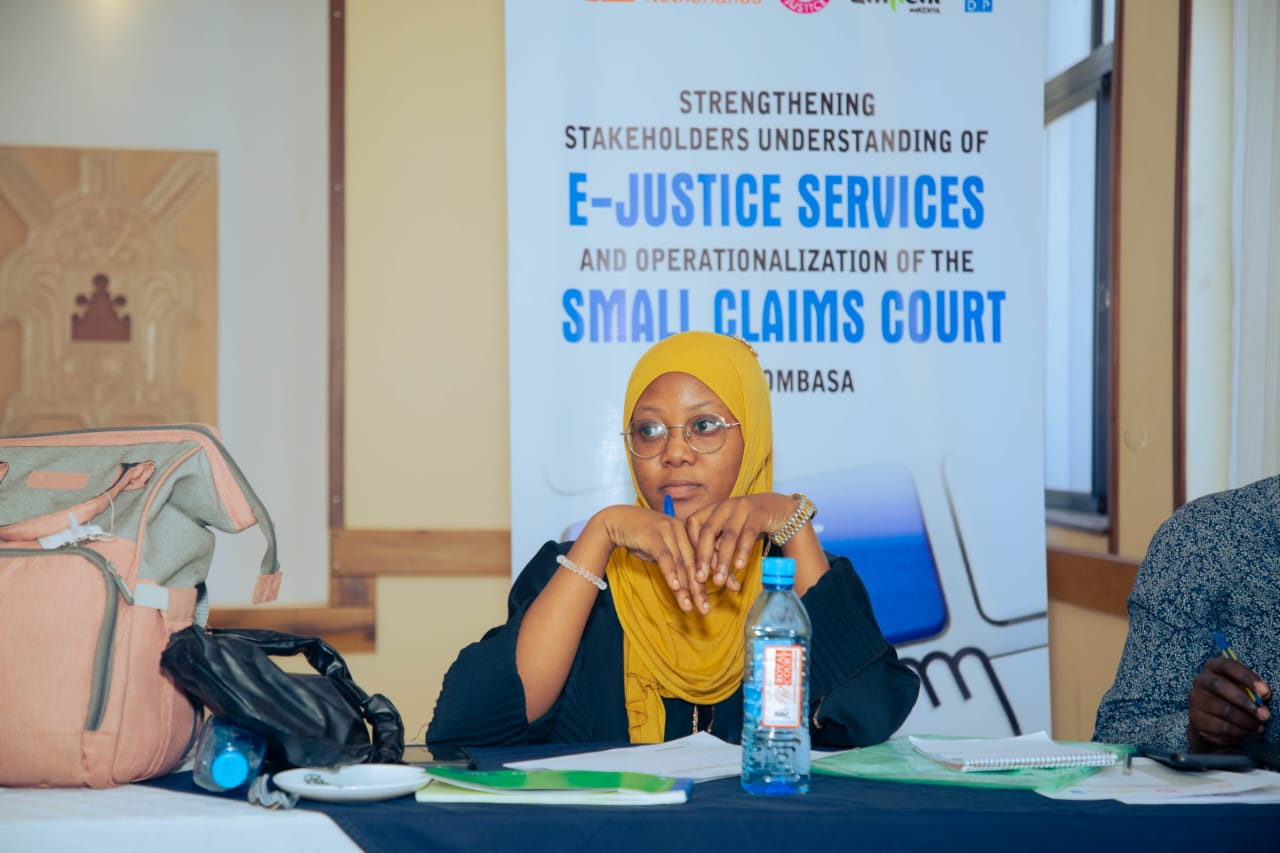
Representatives of the National Legal Aid Services and the Law Society of Kenya reflect on the Small Claims Court opportunities at the meeting in Mombasa County organized by Sisters for Justice and UNDP.
The partnership between UNDP and the Judiciary led to the establishment of Court Users Committees (CUCs) for Mombasa’s SCC, the first SCC in Kenya to have a formalized CUC. This committee brings together justice actors, civil society organizations, the business community and administrative representatives. It serves as a structured forum where regular users of the SCC can share best practices, provide feedback, address emerging issues and collectively resolve challenges. The CUC has also established a Community of Practice (COP) which is acting as an online knowledge sharing platform for the members. Beyond supporting transparency, accountability and improved access to justice, the CUCs also play a critical role in resolving administrative issues that affect court operations. More broadly, the general functions of these committees encompass the identification and resolution of both administrative and justice-related concerns faced by the court. This collaboration has enhanced the Judiciary’s institutional capacity and ensured the effective integration of digital tools, such as the SCC mobile application, into the justice system, ultimately reducing case resolution time and improving overall efficiency.
To address capacity gaps among judicial officers, UNDP’s Accelerator Lab is developing e-learning content in partnership with the Kenya Judiciary Academy (KJA). Additionally, strong partnerships with key stakeholders, including the UN Office on Drugs and Crime (UNODC), has enabled UNDP to leverage broader initiatives to enhance access to justice for Kenya’s most vulnerable populations, including youth, minority groups and persons with disabilities.
To empower women and marginalized groups to better access and utilize the SCCs services, UNDP supported CSOs in Mombasa County in addressing barriers that hinder women traders' access to justice. Nine strategic engagement forums with women-based and women-led organizations were held in 2024, which provided a platform for women traders to openly discuss the obstacles they face in accessing justice through the SCCs. This process is a critical step towards achieving gender equality and supporting women’s economic empowerment, since many of these women serve as the primary breadwinners for their households.
Other interventions designed to raise awareness and deepen public understanding of the SCCs and their processes, targeting small business owners and vulnerable communities, included legal aid clinics, community dialogue forums and capacity-building workshops that reached almost 900 individuals, half of them women. Five legal aid clinics, for example, provided critical legal tools to small-scale traders on the operations of the SCCs, with a focus on debt recovery and self-representation. In addition, eight radio talk shows,which reached an estimated audience of over 5.3 million listeners, were held. This large-scale awareness effort has significantly contributed to increased public confidence in accessing justice through the SCCs.
Looking forward
While UNDP SCC interventions have targeted CUCs, and through legal aid clinics and other strategic engagements reached out to other targeted groups such as small business traders and women as primordial users, the potential to scale and expand is enormous. The SCCs are poised to meaningfully impact access to justice and foster transparency and accountability within the justice system. Noting that the SCCs application design is scalable and adaptable to other judicial contexts or regions, it has the potential to serve as a model for integrating technology into other areas of the justice system. It also has the capacity to improve access to justice by reducing case backlogs and increasing overall efficiency across Kenya’s judicial system.