
Democratic Republic of the Congo
Countries & Territories


Key results
- The introduction of four groundbreaking digital tools in the criminal justice chain enhanced transparency, efficiency and record-keeping, reducing case processing times and corruption risks.
- Efforts to reduce prison overcrowding included mobile court hearings, resulting in over 100 case considerations and detainee releases, with fair trial guarantees and financial compensation for victims.
- UNDP strengthened collaboration between alternative dispute resolution mechanisms and the formal justice system, enhancing the legitimacy and sustainability of mediated outcomes, and trained local mediators in conflict resolution with a focus on human rights and gender considerations.
In the Democratic Republic of the Congo (DRC), UNDP coordinated the implementation of the UN Joint Programme to Support Justice Reform (2020-2024). Developed in collaboration with the Ministry of Justice and the Supreme Council of the Judiciary (CSM), the programme strengthened the rule of law through a holistic and multidimensional approach to supporting the criminal justice chain. The efforts to improve governance and coordinate the National Justice Reform Policy are implemented at the central level in Kinshasa, the capital, while interventions for accountability and access to justice cover Kasaï Central, Tanganyika and North Kivu.
The Joint Programme is strategically aligned with key UN, national, and regional frameworks guiding peacebuilding, governance and human rights in the Democratic Republic of Congo. It contributes directly to the UN Sustainable Development Cooperation Framework (UNSDCF 2020–2024), particularly Strategic Priority 1 on peace consolidation, human rights, protection of civilians, social cohesion and democracy. It also aligns with the Integrated Strategy for the Stabilization of the East (ISSSS), the UN Stabilization Mission in the Democratic Republic of the Congo (MONUSCO) regional strategies and UN Security Council Resolution 2502. The programme contributes to the achievement of SDG 16 and UNDP DRC’s Country Programme Document (CPD 2020–2024).
Under the CSM supervision, the programme was implemented by MONUSCO, the UN Joint Human Rights Office (UNJHRO), the Team of Experts on the Rule of Law and Sexual Violence in Conflict (ToE) and UNDP. The UN Global Focal Point for the Rule of Law (GFP) has supported the programme since its inception, through UNDP’s Global Programme for Strengthening the Rule of Law, Human Rights, Justice and Security for Sustainable Peace and Development. For sustainability and national ownership, the programme operated in partnership with the Ministry of Justice, Ministry of Human Rights, the Supreme Council of the Judiciary, Bar Association, and other agencies at national and provincial levels.
In 2024, the complex political and security context in the DRC affected the programme’s implementation. On the political front, following the President’s re-election for a second term, major reforms were initiated to strengthen the rule of law and judicial independence. The Prime Minister presented an ambitious programmme aimed at restoring public confidence in institutions, with the judicial sector among the priorities. At the same time, the security situation in the east of the country, marked by armed conflicts and the state of siege in provinces such as North Kivu, severely impacted access to justice and programme operations. Furthermore, within the framework of MONUSCO’s transition, the programme had to ensure sustainability of the progress achieved in the field of justice, particularly in areas where the mission has disengaged.
As a breakthrough achievement, four digital tools were developed and introduced in the criminal justice chain, in collaboration with judicial authorities. These tools enhance transparency and efficiency across judicial and penitentiary systems. A Prisoner Management Information System was deployed in 12 cities to streamline detainee record-keeping. Judicial and prosecution offices benefited from a Judicial Activities Management System, which reduced case processing times and improved oversight through real-time performance dashboards. The Magistrates Management System brought greater transparency to the handling of magistrates' records, while the Criminal Record Management System simplified digital access to archives and strengthened the management of criminal records. Together, these tools support real-time monitoring, accurate data reporting and better record-keeping, while also helping to detect procedural errors and reduce corruption risks.
One of the programme’s key priorities was to reduce prison overcrowding, exacerbated by the state of siege and the expanded jurisdiction of military courts. At Goma Central Prison, for example, 4,000 people were held in pre-trial detention despite its capacity being approximately 350. To expedite case consideration, the programme organized mobile court hearings in North Kivu, Kasaï-Central and Tanganyika. Over 100 cases were considered, including related to war crimes, sexual violence and child conscription. Over 100 detainees were acquitted and released. Fair trial guarantees were observed, with lawyers providing legal assistance to all the defendants. In Kasaï-Central, for example, 232 victims, 60 percent women and young girls, participated in the hearings as civil parties, assisted by legal counsel. For all of them, the court awarded individual financial compensation as reparation for their suffering. To guarantee consistent legal assistance for vulnerable individuals, UNDP signed an agreement with the Tanganyika Bar Association.
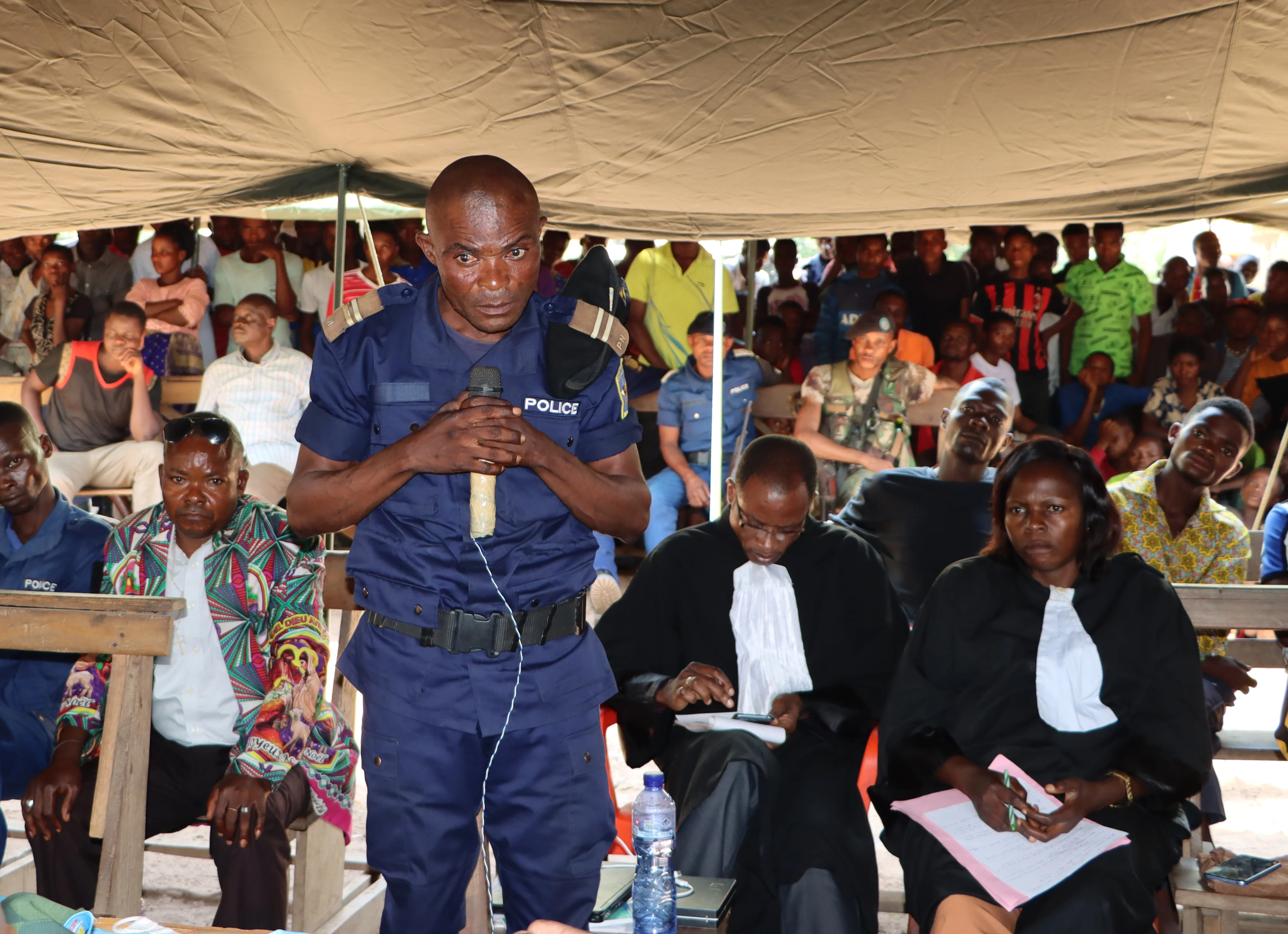
Mobile court hearing of the Military Court in Kasai Central.
During regular judicial proceedings, three priority cases related to international criminal law violations were considered at the appeal level in Kasaï-Central, resulting in two final rulings on the merits. To achieve this, UNDP coordinated the collaboration among many national and international partners, including national military justice actors, the Kasaï-Central Bar Association, a public body for protection and reparation (FONAREV), the UN Human Rights Office and TRIAL International.
Over 320 civilian and magistrates, including 85 women, in North Kivu, Kalemie, Kasaï Central, Tanganyika and Kinshasa strengthened their competencies in ethics, professional conduct and anti-corruption measures. This intervention aimed to promote transparency and reduce misconduct in the judicial system by raising magistrates' awareness of their responsibilities. Furthermore, 750 copies of an updated practical guide on magistrates’ disciplinary procedures were handed over to the CSM to further build the magistrates’ capacity.
Under the framework of the Joint Programme, UNDP made efforts to strengthen collaboration between alternative dispute resolution (ADR) mechanisms and the formal justice system, promoting their integration and the validation of mediation records. While litigants in the DRC often prefer ADR mechanisms for their accessibility and cultural relevance, they lack enforceability. To address this, UNDP supported the recognition of mediated outcomes by the courts, aiming to enhance the legitimacy, effectiveness and sustainability of ADR processes while ensuring alignment with legal standards and human rights principles. In the provinces of Kasaï and Tanganyika, Alternative Dispute Resolution (ADR) workshops were conducted for 50 local mediators (including 17 women and 17 youth), enhancing their skills in conflict resolution with a specific focus on integrating human rights and gender-sensitive approaches into their practices.
In parallel to the implementation of the joint justice reform programme, the Global Focal Point supported the review of the Police Programme in DRC. A series of technical review sessions were convened to update the programme document in close collaboration with MONUSCO, UN Police/Security Sector Reform, the UN Human Rights Office, International Organization for Migration, the UN Human Settlements Programme (UN-HABITAT), the UN Mine Action Service (UNMAS), and national authorities. The participatory process allowed for the substantive enrichment of the document, ensuring alignment with national priorities and coherence with the mandates of involved stakeholders. All partners have formally endorsed the new programme document. When this report was drafted, preparations were underway to convene the Steering Committee for the formal launch and further coordination.
Looking forward
Building on lessons from the 2020–2024 phase, the 2025–2029 UN Joint Programme for Justice Reform will consolidate gains and scale up impactful initiatives. It will expand digital justice tools to improve transparency, efficiency and case tracking across the criminal justice chain. The success of mobile court hearings will be reinforced, with continued efforts to reduce pre-trial detention and prison overcrowding, while ensuring fair trial guarantees and victim compensation. The programme will deepen the integration of alternative dispute resolution mechanisms into the formal justice system, promoting legal recognition and sustainability. Training for local mediators will be strengthened, with a strong focus on gender and human rights, to enhance access to justice for vulnerable groups and support national justice reforms.
* Country profiles marked as GFP detail results achieved under the framework of the Global Focal Point for the Rule of Law, a UN partnership mechanism coordinated by UNDP and the UN Department of Peace Operations