
Human rights systems
Countries & Territories
Overview
Amidst significant global pressures on human development, including polycrises and persistent inequality within and between states, human rights remain a pathway to solutions, playing a critical role as a preventative, protective and transformative force for good.
UNDP works to support human rights solutions that strengthen accountability, protect communities and foster peace, recovery and stability. In 2024, UNDP has sustained investments in strengthening national human rights systems, including supporting national human rights institutions (NHRIs) globally.
Technology is profoundly reshaping the human rights landscape. While digital tools can amplify voices or expand access to justice, they also risk perpetuating inequalities and exclusion. UNDP has continued to work on rights in the digital realm, improving the understanding of the connections and approaches required to address the digital divide and promoting safe, inclusive systems for rights-based digital transformation.
UNDP has expanded its toolbox on human rights mainstreaming to include updated guidance on Human Rights Due Diligence for work with the non-UN security sector and a new UNDP toolkit on human rights-based approaches for development programming, which builds on 20 years of UNDP experience. These tools bring innovative ways to solve contemporary development problems, asserting that human rights are not abstract ideals. They are vital tools for addressing pressing challenges for development and advancing dignity and justice for all.


Support to national human rights systems
In 2024, UNDP supported human rights institutions, systems and stakeholders in 63 countries and territories. The Global Programme for Strengthening the Rule of Law, Human Rights, Justice and Security for Sustainable Peace and Development provided support in 47 countries and territories.
Support to strengthen capacities of human rights institutions, systems and stakeholders toward the fulfillment of nationally and internationally ratified human rights obligations (incl. TPP) = 28
Recipient countries of Tri-Partite Partnership support = 16
Results Framework indicator 1.2
Number of contexts where human rights institutions, systems or stakeholders supported by the Global Programme strengthened capacities to support the fulfilment of nationally and internationally ratified human rights obligations.
Support to implementation of UPR recommendations and closer integration between human rights and SDG systems = 13
Results Framework indicator 2.1
Number of contexts in which the Global Programme’s support has contributed to:
a) implementation of UPR recommendations;
b) closer integration between human rights and SDG systems.
Support to strengthen capacities of rule of law and justice institutions toward the fulfilment of nationally and internationally ratified human rights obligations (incl. HRDDP) = 23
Support to Human Rights Due Diligence Policy reviews = 8
Results Framework indicator 3.1
Number of contexts where the Global Programme’s support to rule of law and justice institutions, systems, or stakeholders has strengthened capacities to support fulfilment of nationally and internationally ratified human rights obligations.
National human rights institutions
A key part of strengthening national human rights systems is partnering with and building the capacities of NHRIs. As frontline human rights defenders that promote and protect human rights, NHRIs face many interrelated challenges at national level. By empowering NHRIs to fulfill their mandates effectively through bolstering their operational capacities and enabling them to prevent and address pressing human rights challenges, UNDP can advance human rights and sustainable development globally.
Amongst broader support to NHRIs, UNDP provides a platform to leverage UN collaboration to support NHRIs by scaling up support through the TriPartite Partnership to Support National Human Rights Institutions (TPP).
With support from the Government of Norway, this collaborative initiative leverages the partnership of UNDP and the UN Human Rights Office, along with global and regional networks of NHRIs, to respond to the increasing demands and challenges that NHRIs face through joint programming. In 2024, the TPP supported 13 NHRIs at country level to protect and promote human rights, strengthened NHRI capacities on digital and environmental rights through the development of targeted toolkits, engaged 40 NHRIs in policy tool development and enabled their participation in global policy forums.
Tailored to each country's specific needs, the TPP has provided support to NHRIs in Comoros, Costa Rica, Ecuador, Georgia, Jordan, Malawi, Maldives, Moldova, Nigeria, North Macedonia, Peru, Timor-Leste and Ukraine.
In Costa Rica and Nigeria, the TPP assisted in developing Human Rights Observatories to strengthen early warning systems for conflict trends and prevention, which supported the adjudication of 210 human rights cases across six states in Nigeria. In Georgia, a monitoring methodology for the right to water was created. In Malawi, the TPP supported monitoring of 43 detention facilities, prompting renewed government commitments to improve conditions and uphold the rights of detainees. In Peru, partnerships were established with regional Ombudsperson’s Offices, engaging over 300 officials and civil society representatives to carry out peacebuilding activities.
Looking forward
In a global context of under investment in human rights and development, UNDP is committed to providing critical support to robust national human rights systems and NHRIs.
In 2025, UNDP will continue to provide coordinated support to more governments to establish and strengthen Paris Principles compliant NHRIs as key institutions for prevention, early warning and achieving the SDGs. Practical demand-driven tools for NHRIs will be launched to assess their digital readiness and monitor the right to a healthy environment. A new UN NHRI toolkit will be designed as a critical resource to expand understanding and leverage greater engagement with NHRIs across the UN system. Finally, UNDP will sustain investments and results in countries where the UN system has been leveraged to work jointly with NHRIs through the TPP.
Rights-based digital transformation
To strengthen UNDP’s commitment to a rights-based digital transformation, in 2024 UNDP finalized the development of an innovative tool, the Digital Rights Dashboard (DRD), to expand on the UNDP Digital Development Compass with knowledge on the intersection of digitalization and human rights. The DRD offers insights into digital rights trends, identifies gaps, and informs evidence-based policy decisions. Over time, the DRD will help governments, civil society organizations and other stakeholders to strengthen safeguards and uphold human rights in the digital space.
The development of the DRD involved comprehensive data collection and desk research, complemented by insights from other UNDP tools such as the Digital Development Compass (DDC) and Digital Readiness Assessments. Piloted in five countries (Colombia, Lebanon, Mauritania, North Macedonia and Samoa), the DRD provided clear insights on the intersection between human rights and digital transformation, including the right to privacy; the right to freedom of expression, assembly and association; the right to equality and non-discrimination; and the right to access to the internet. By engaging UNDP Country Offices in piloting the DRD, the initiative raised awareness of digital rights and strengthened internal capacity to integrate human rights considerations into digital transformation efforts.
Looking forward
Once launched in 2025, the DRD will serve as a valuable tool for UNDP and national partners, helping guide national strategies by drawing on good practices and comparative insights. By leveraging the DRD, countries can refine their approaches to human rights-based digital development and work toward more inclusive and rights-based digital frameworks that ensure protection for all.
Human rights mainstreaming
UNDP supports the mainstreaming of human rights throughout development programming, viewing it as a key programming principle. Utilizing a human rights-based approach in development programming can help UNDP to improve its delivery for populations and governments around the world. It can be an enabler of progress, engaging whole societies and unpacking development challenges whilst providing solutions pathways. It’s a tool to anticipate, prevent and manage risks. UNDP believes that a human rights-based approach will assist in upholding human dignity, fundamental for all human progress.
Human rights-based approach to development programming
Finalized at the end of 2024 by UNDP, The Human Rights-Based Approach (HRBA) to Development Programming: HRBA Toolkit is a groundbreaking resource designed to integrate human rights principles into sustainable development programming. Developed through an extensive listening and learning exercise with 36 UNDP Country Offices and a dedicated UNDP-wide reference group, the Toolkit builds on over two decades of UNDP expertise in human rights mainstreaming. It is a structured, practical guide for embedding human rights standards throughout the development project cycle, strengthening accountability, inclusion and resilience. Aligned with the UNDP Social and Environmental Standards, the toolkit ensures a rights-based foundation for programmatic decision-making, fostering collaboration between duty bearers and rights holders to develop sustainable, crisis-responsive programming.
At its core, the Toolkit elaborates on the three-step human rights analysis and introduces the PLANET framework to systematically integrate human rights considerations into programme design, implementation and evaluation.
PLANET stands for
Participation
Linkages
Accountability
Non-discrimination
Equality, Empowerment and Capacity Development
Transparency
By anticipating risks, preventing crises and promoting peace, the Toolkit serves as a critical problem-solving tool for contemporary development challenges, guiding practitioners toward more effective and equitable programming.
Human rights due diligence policy
In 2024, UNDP supported eight countries and territories in the application of the Human Rights Due Diligence Policy for projects that engage with the non-UN security sector to ensure engagements are aligned with international human rights standards. By integrating a rights-based approach, UNDP actively managed, monitored and mitigated risks associated with security sector engagement.
In 2024, UNDP updated its Human Rights Due Diligence Policy Implementation Tool to improve its usability and provide clear guidance and a structured risk assessment framework to help UNDP Country Offices systematically evaluate and mitigate human rights risks when engaging with the non-UN security sector. By strengthening capacities and knowledge of human rights due diligence for the security sector, UNDP enhances the effectiveness, sustainability and accountability of its interventions, reinforcing commitment to human rights protection.
Looking forward
2025 will focus on rolling out these critical human rights mainstreaming tools across UNDP to improve human rights-based programming and rights-based engagement with the security sector. Dedicated training on both tools will be introduced across the organization, accompanied by targeted capacity building support and localized case studies. Alongside the new guidance for the human rights programming marker to be rolled out in 2025, these efforts will improve both technical knowledge and capacities to reinforce practical learning, highlight best practices and to strengthen risk anticipation, promote crisis prevention to ensure that development efforts are equitable, inclusive and sustainable.
Engagement at the Human Rights Council
In 2024, UNDP engaged at the Human Rights Council to provide evidence-based development perspectives to policy debates and strengthen partnerships for sustainable development. UNDP’s strategic engagement contributed practically at 13 thematic and technical discussions at the Human Rights Council to further technical cooperation, including on climate change, human rights and the environment, judges and lawyers, and the rights of Indigenous Peoples.
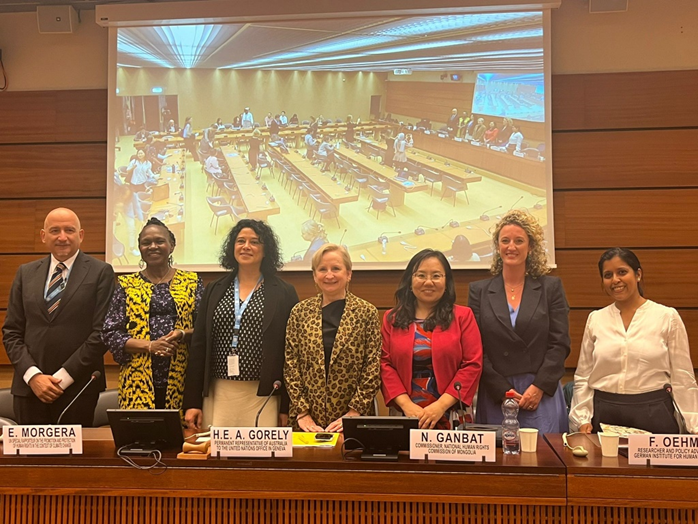
Human Rights Council 56th session, side event on Fostering Human Rights and Business Accountability in the Context of Climate Change.