

Côte d’Ivoire
Countries & Territories


Key results
- 1,710 people obtained official civil documents, including birth certificates, nationality certificates and national identity cards. This includes 1,600 people in eight villages of Tchologo and Bounkani who received IDs and were enabled to exercise civil, political, social and economic rights.
- More than 8,000 people, including 5,200 women, were reached through two community awareness campaigns designed to promote the importance of civil documentation and encourage participation.
- Four community dialogue meetings were organized between the Defense and Security Forces (FDS) and local communities, with the participation of over 400 people, including 105 women, to strengthen trust and build a framework for community security.
- Two training sessions were organized for the FDS representatives, community, women and youth leaders on human rights, including freedom of movement and preventing abuse from the side of security forces.
In Côte d'Ivoire, UNDP promoted the right to identity, as well as equal access to justice and public services in the northern border areas of the country. Communities in these territories (in particular, the Tchologo and Bounkani regions) have long suffered from an unstable security situation, exacerbated by the instability in neighboring Mali and Burkina Faso. Recently, cross-border movement has surged, including the influx of over 60,000 asylum seekers. Upscaled security measures around the northern borders which included intensified security checks created additional obstacles for people without identification documents (IDs), bringing more relevance and urgency to the project supported through UNDP’s Global Programme for Strengthening the Rule of Law, Human Rights, Justice and Security for Sustainable Peace and Development (the Global Programme).
As the issue of access to administrative documents is a cross-cutting challenge involving several national and local actors, UNDP developed an integrated approach, partnering with the National Identification Office (ONECI), the Ministry of Justice, the Ministry of the Interior, the Ministry of Economy, the mayors of the communes, regional councils and the National Human Rights Council (CNDH), engaging also with media and youth organizations. The leadership of the Ministry of the Interior and the Ministry of Economy was instrumental in the success of this national effort. Combined with ONECI’s technical expertise, it laid a solid foundation for the results achieved. This collaborative approach strengthened national ownership at every stage and enhanced coordination among all partners.
The project was made possible thanks to the financial support of Germany, through a larger programme aimed at promoting youth and women’s engagement to reduce conflicts and consolidate peace in northern Côte d’Ivoire.
The project’s close cooperation with UNICEF allowed it to reach youth and families, including children from the Fulani ethnic group, most of whom had no administrative documents.
As the key achievement of the initiative, 1,710 people, almost a third of them were women, received personal documents, such as identification documents (issued for 1,600 people in eight villages in the Tchologo and Bounkani regions), birth certificates and nationality certificates.
“I am so happy. It used to be very difficult for me to travel. Sometimes they asked me to show my identity card, and I felt shame. I was afraid of the police because I didn't have a card. But today, everything changed,” – said one of the beneficiaries from the locality of Nassian.
With identification cards, people will be able to exercise their civil, political, social and economic rights, including to move freely, open bank accounts, apply for income-generating state grants that will ultimately ensure their empowerment.
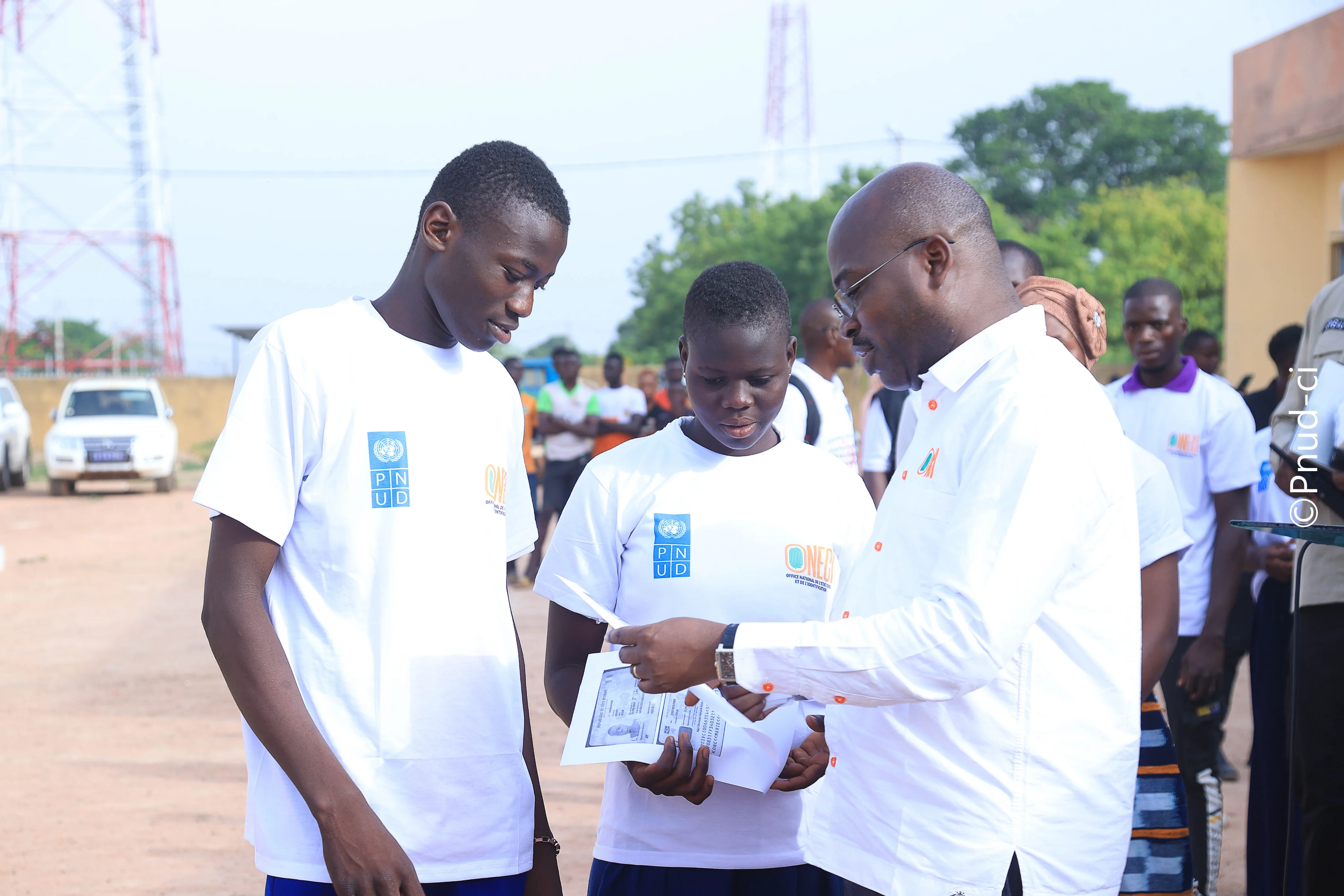
Over 1,700 people in Côte d’Ivoire obtained official civil documents, including birth certificates, nationality certificates and national identity cards, enabled to exercise civil, political, social and economic rights.
To leave no one behind, UNDP and ONECI set up mobile teams that visited the elderly and persons with disabilities in their homes to issue and certify the documents. In addition, during the rainy season, the team went to the locality of Nafoungolo in the sub-prefecture of Diawala, as residents could not leave due to flooding.
To inform communities about the registration benefits and encourage participation, UNDP supported ONECI in organizing two awareness raising campaigns in Niéllé, Kaouara, Tehini and Nassian (Tchologo region), targeting mostly young people and women. Community and civil society leaders, as well as religious guides, were successfully engaged as intermediaries. More than 8,000 people were reached, including over 5,200 women. To ensure a smooth registration process, two workshops were organized for gendarmerie brigades, police, traditional community chiefs, local peace committees, and community volunteers.
The CNDH was UNDP’s key partner in the awareness-raising and capacity building activities. It also worked directly with the communities to follow up on the rejection appeals, ensuring that no one was denied an ID due to discriminatory practices. As a result, 94 rejection claims were resolved. To ensure that security measures in the cross-border regions do not affect the rights of the local population, UNDP organized four meetings between the Defense and Security Forces (FDS) and communities to develop a dialogue framework for community security. Over 400 people participated, including 105 women. Finally, two training sessions were organized for the FDS and community representatives, women and youth leaders on human rights, including freedom of movement and preventing abuse from the side of security forces. In a few statements made during public events, the FDS officials called on the ranking officers to avoid negative or harmful behaviour to maintain peaceful social climate.
Following a needs-assessment exercise, UNDP provided equipment for civil-military committees that will contribute to awareness-raising and improve early warning mechanisms and community dialogue, preventing conflicts between security services and communities.
Looking forward
The need for identification documents remains high. At its next stage, the project will reinforce its focus on women and youth, establishing a climate of peace and trust between communities and the FDS, benefitting from the funding opportunities offered by the Government.
UNDP will strengthen the material resources of civil registry structures and provide administrative support to facilitate connection between remote communities and urban administrative centres.