
Mozambique
Countries & Territories


Key results
- A comprehensive assessment of 55 community courts across four provinces identified critical gaps in infrastructure, staffing and legal services, guiding future investments to enhance grassroots justice delivery, particularly for women and vulnerable groups.
- In collaboration with national institutions, UNDP launched a rehabilitation programme in Cabo Delgado prisons, equipping 100 inmates and five officers with vocational skills and introducing a de-radicalization workshop and handbook to prevent violent extremism within the prison system.
- UNDP significantly strengthened the National Human Rights Commission by delivering foundational training to new commissioners, supporting four monitoring missions, and facilitating civil society engagement in the Universal Periodic Review process to enhance accountability and human rights governance.
- In December 2024, UNDP’s workshop in northern Mozambique brought together 47 stakeholders to identify gaps in legal and health services for women and girls affected by insurgency, leading to commitments to restore integrated support and establish a collaborative network.
Mozambique experienced several challenges in providing legal services and fulfilling human rights obligations. In 2024, the sociopolitical landscape was defined by the general elections and subsequent governmental transitions. This context presented both opportunities and challenges that influenced the design, implementation and adaptation of interventions supported through UNDP’s Global Programme for Strengthening the Rule of Law, Human Rights, Justice and Security for Sustainable Peace and Development. The interventions focused on closing critical gaps in legal services and improving human rights protection for marginalized groups, particularly women affected by conflict, internally displaced persons and youth. It prioritized expanding access to justice, advocating for legal reforms in conflict-affected areas and reinforcing National Human Rights Institutions.
Through partnerships with civil society organizations (CSOs), most notably the We Belong Africa (WBA) project, the initiative strengthened advocacy and capacity building efforts, fostering resilience and promoting more equitable legal frameworks. Amid the heightened political activity of the election year, strategic engagement with stakeholders ensured the project’s visibility and alignment with evolving government priorities. This led to greater inclusion of marginalized voices in policy discussions and created momentum for legal and social reforms. By addressing institutional gaps and amplifying the rights of vulnerable populations, UNDP has advanced a more inclusive and sustainable approach to justice and human rights. Serving as a catalyst for change, the initiative continues to bridge the gap between policy and practice, facilitating dialogue among communities, civil society and government actors. It is laying the foundation for long-term improvements aligned with national rule of law and human rights priorities, even in the face of political uncertainty.
UNDP made significant strides in strengthening access to justice and promoting human rights in Mozambique, particularly in regions affected by conflict and socioeconomic instability. A major milestone was the comprehensive mapping and needs assessment of community courts across four provinces: Maputo, Nampula, Niassa and Cabo Delgado. This exercise provided detailed insights into 55 community courts, highlighting critical gaps in infrastructure, staffing and legal support services. The data, including gender-disaggregated information, is instrumental in guiding future investments in community-based justice systems, which are vital for rural populations, especially women and vulnerable groups.
Building on this foundation, UNDP supported the drafting of a revised regulation for community courts. This draft, currently under review, aims to formalize and standardize court operations, enhancing transparency, fairness and legitimacy at the grassroots level. These efforts are expected to significantly improve justice delivery in conflict-affected areas.
In Cabo Delgado, UNDP launched a rehabilitation programme for women in conflict with the law, introducing vocational training in cutting, sewing and locksmithing. The initiative, implemented in partnership with national institutions such as the Ministry of Justice, Free Legal Aid Institute (IPAJ) and Alberto Cassimo Institute of Professional Training and Labour Studies (IFPELAC), benefited 100 inmates and five prison officers. Targeting young adults aged 18 to 30, including those convicted of terrorism, theft and domestic violence, the programme promotes social reintegration through skill-building and is set to be replicated in other facilities.
To further strengthen local justice mechanisms, UNDP facilitated roundtables in Cabo Delgado, Nampula and Niassa, bringing together government officials, civil society and community leaders. These discussions addressed judicial and extrajudicial conflict resolution, early marriage prevention and other pressing sociocultural issues.
In Tete province, a regional workshop was held under the framework of UN Security Council Resolution 1325 on Women, Peace and Security. Organized by the Mozambique Police Force, the event gathered 60 participants, including 26 women, to address community-specific conflicts and strengthen trust between law enforcement and local populations. The workshop focused on identifying vulnerabilities of women and girls in conflict and post-conflict zones, improving gender-based violence prevention and enhancing community policing.
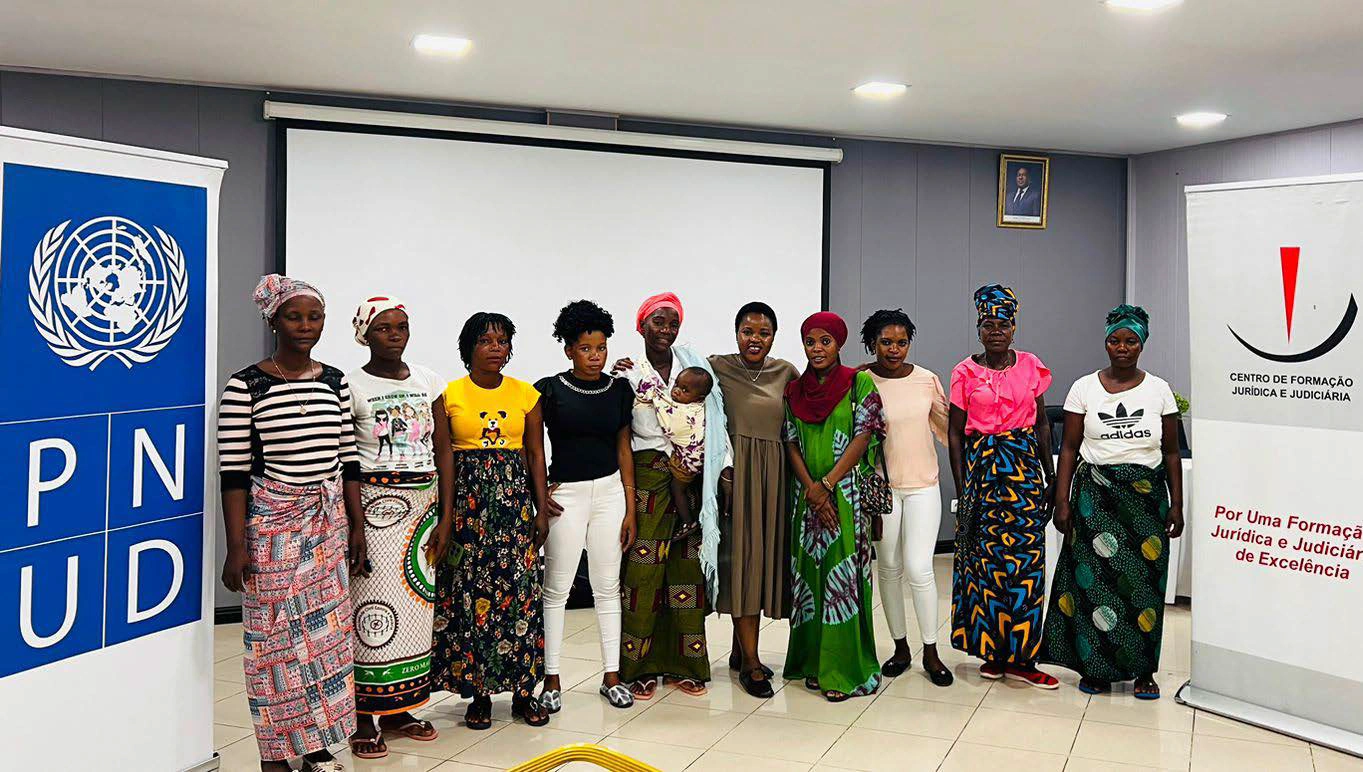
Workshop on strengthening access to justice for women and girls victims of terrorism and violence, Nampula Province, Mozambique.
UNDP also addressed the growing concern of violent extremism through a dedicated workshop on preventing radicalization, particularly within the prison system. Conducted in collaboration with the National Corrections Service (SERNAP), the workshop equipped participants with tools to identify risk factors and implement effective interventions. A comprehensive handbook on de-radicalization was published, offering practical guidance for prison staff and inmates to support rehabilitation and reduce the risk of radicalization.
UNDP has played a pivotal role in strengthening Mozambique’s national human rights architecture, with a focus on enhancing the capacity and effectiveness of the National Human Rights Commission (NHRC) and related institutions. Following the appointment of a new Human Rights Commissioner and the election of nine commissioners to a five-year mandate, UNDP, in partnership with the UN Human Rights Office, delivered a foundational training to equip the new leadership with a solid understanding of human rights principles, governance frameworks and international human rights mechanisms.
To reinforce the Commission’s operational capacity, UNDP supported four monitoring missions to investigate human rights violations, including those linked to business practices and gender-based violence in Cabo Delgado. These missions informed recommendations to local authorities, civil society and the private sector, promoting accountability and systemic change.
UNDP also worked with the Ministry of Justice to advance Mozambique’s commitments under the Universal Periodic Review (UPR). Through seminars in Maputo, Gaza and Inhambane, the government disseminated its UPR Action Plan, reviewed past recommendations, and gathered data for its Fourth National Report. Complementing this, UNDP supported the CSO-led Monitoring Forum of the UPR (FMMRPU), a coalition of around 120 non-governmental organizations. This platform has been instrumental in tracking implementation, engaging in dialogue with the government, and preparing shadow reports, ensuring that civil society plays a central role in promoting transparency and accountability in human rights governance.
To advance the business and human rights agenda in Mozambique, UNDP partnered with the UN Human Rights Office, UNICEF and the European Union to support inclusive consultations for the development of the Government’s National Action Plan (NAP), aligned with the UN Guiding Principles on Business and Human Rights. In 2024, the NAP was officially validated during a seminar led by the Ministry of Justice, Constitutional and Religious Affairs, which brought together representatives from various government institutions, human rights focal points, CSOs, representatives of the extractive industries and UN agencies.
Together, these initiatives reflect UNDP’s holistic and community-centred approach to justice reform in Mozambique, reinforcing the rule of law, promoting human rights and building resilience in vulnerable communities. The project is fully aligned with Mozambique’s national plans and sectoral priorities, ensuring that its activities are integrated into government systems.
Looking forward
UNDP Mozambique will continue supporting the work of the Government, National Human Rights Commission, CSOs and the Ombudsperson. Key support will focus on the preparation for the fourth cycle of the UPR process, Business and Human Rights work in the North, the decentralization of the NHRCs through the establishment of its sub-office in Pemba, support to legal reform (revision of the NHRCs law aimed at better alignment to Paris Principles) and the establishment of a case management system in the NHRC to strengthen its capacity on complaint handling and case monitoring. For the first time, work will begin on human rights in the context of climate change, violent extremism and COVID-19 in Mozambique in partnership with CSOs.