
Business and human rights
Countries & Territories
Overview
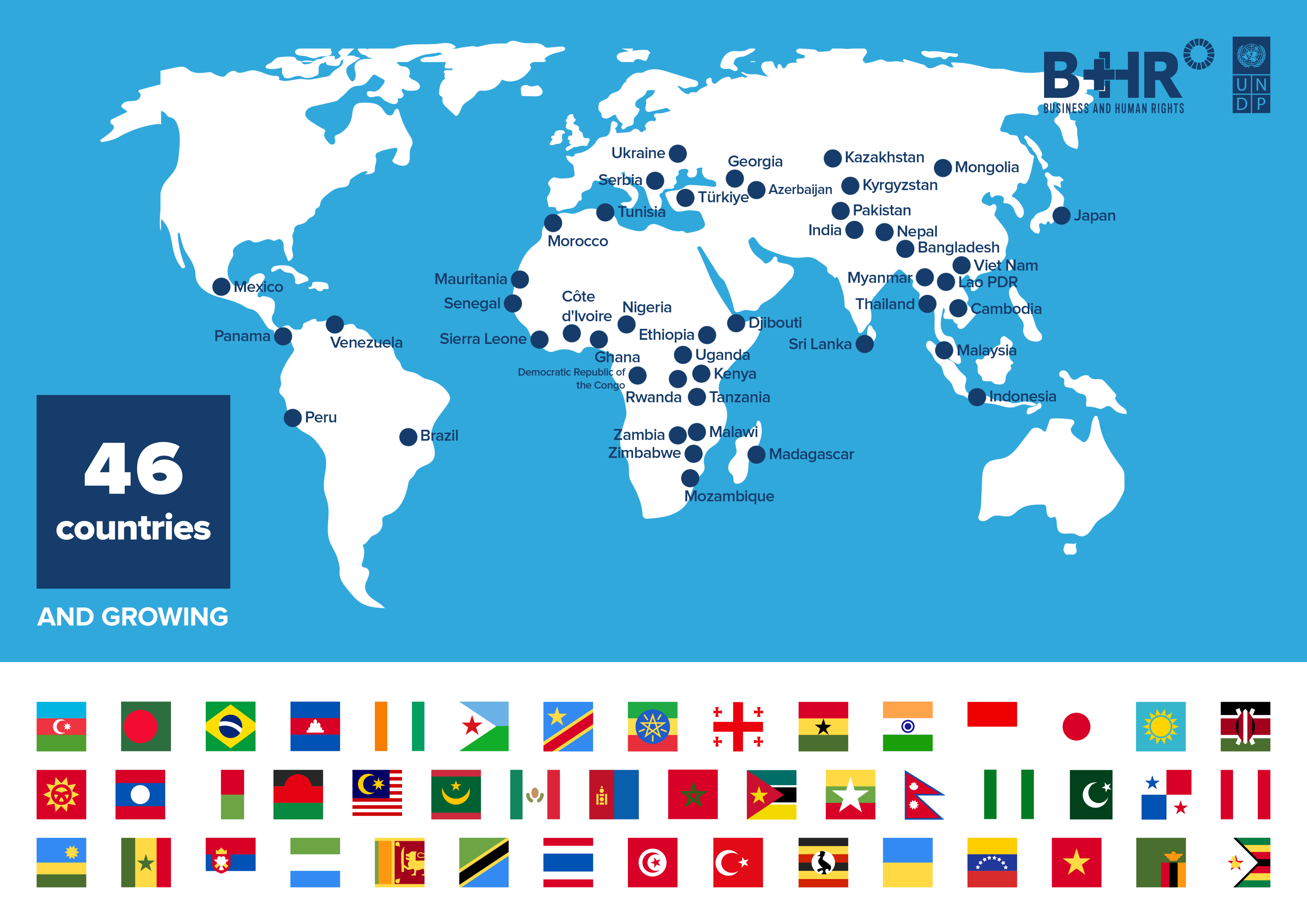
In 2024, the UNDP Global Business and Human Rights (B+HR) Initiative expanded to 46 countries in Africa, Arab States, Asia and the Pacific, Europe and Central Asia, Latin America and the Caribbean, with support from the European Union, Japan, Liechtenstein, Netherlands, Sweden and the United Kingdom. Through the Initiative, UNDP assisted governments, businesses, civil society organizations (CSOs), labour organizations, national human rights institutions (NHRIs), environmental and human rights defenders, media, and others, in advancing responsible business practices.
Business and Human Rights: global coverage
In 2024, UNDP expanded its work on BHR in Africa and Asia, launching new projects in Cambodia, the Democratic Republic of the Congo (DRC), Ethiopia, Madagascar, Mauritania, Rwanda, Tanzania and Zimbabwe, while bolstering efforts in Europe and Central Asia, Latin America and the Caribbean.
UNDP prioritized “sustainable finance” and “youth” as new thematic areas, having launched the global Finance Against Slavery and Trafficking (FAST) Initiative and the Agents of Change project in Asia. It also maintained thought leadership and continued setting best practice for business in the “environment” and “peace” thematic areas, publishing a Practical Tool for Business on Human Rights Due Diligence and the Environment and operationalizing the 2022 Guide on Heightened Human Rights Due Diligence for Business in Conflict-Affected Contexts through a training facilitation manual.
The 2024 European Union (EU) Corporate Sustainability Due Diligence Directive (CSDDD) explicitly recommends businesses follow the Guide on Heightened Human Rights Due Diligence. It was referenced in several reports by the UN Working Group on Business and Human Rights and the 2024 Report of the UN High Commissioner for Human Rights on business in the State of Palestine. Additionally, a number of metrics for social taxonomies and trafficking-related disclosure laws issued by the Inter-Agency Coordination Group against Trafficking in Persons in 2024 are based on UNDP knowledge products.
UNDP continued playing an instrumental role in the Global Community of Practice on Business and Conflict by co-hosting it with the Thinking Ahead for Societal Change (TASC) Platform and the Geneva Trade Platform, and continuing to serve on its Advisory Board and facilitating practitioners’ meetings.
To accelerate South-South exchanges, peer learning and collaboration on B+HR, in 2024, UNDP and its partners convened annual regional forums and dialogues in Asia-Pacific, Africa, Arab States, Europe and Central Asia. Together, the four events conducted 126 sessions for 2,683 stakeholders joining in person and online.
Recommendations generated during the UNDP-led regional forums and dialogues contributed to the 13th UN Global Forum on BHR, where UNDP was involved in 13 sessions and side events, including the one co-organized with the EU on the opportunities and challenges of the CSDDD.
UNDP’s technical assistance to governments in developing National Action Plans (NAPs) on B+HR yielded significant results, with NAPs adopted in Ethiopia, Kyrgyzstan, Liberia and Nepal. Moreover, UNDP supported the finalization of draft NAPs in three countries and supported NAP implementation and decentralization in ten countries.
In 2024, UNDP enhanced its capacity-strengthening support to businesses at the global level. For example, in cooperation with Drive Sustainability, it trained 40 businesses from the automotive industry on the environmental dimensions of human rights due diligence and, in partnership with the Investor Alliance for Human Rights and the Principles for Responsible Investment Initiative, trained 60 investors on heightened human rights due diligence. To facilitate the corporate shift towards integrated human rights and environmental due diligence, UNDP delivered training to over 900 practitioners from the International Association for Impact Assessment.
Efforts in 2024 demonstrated the need to complement the existing UNDP programming on access to remedy targeting victims of business-related abuses with direct support to the business sector on establishing operational-level grievance mechanisms. As stakeholder engagement in human rights due diligence remains a challenge for many businesses, particularly those with long and fragmented value chains, authoritative tools on how to engage with affected rights-holders in a meaningful way are required. Moreover, practical guidance on human rights due diligence in the financial sector, as well as access to contextualized data for human rights risk management and investment decision-making, particularly in conflict-affected contexts, are necessary.
Looking forward
In 2025, UNDP will continue advancing responsible business practices globally, focusing on the existing workstreams, by launching, for example, an e-course on heightened human rights due diligence and developing guides and capacity-strengthening modules for investors.
UNDP will also explore new programming on reliable context data for investment decision-making in conflict and conduct research on the business case for mandatory human rights due diligence. This new programming will take place while also scaling work on the youth and media pressure, effective remedy and meaningful rights-holder engagement, particularly with those at heightened risk of vulnerability and marginalization.
Supporting responsible supply chains with support from the Government of Japan
In 2024, the partnership between UNDP and the Government of Japan continued to advance responsible business practices, expanding its support to businesses and governments across 11 countries. Building on the achievements of earlier phases, the third year of the partnership focused on translating the UN Guiding Principles on Business and Human Rights (UNGPs) into tangible action, both at the policy level and throughout supply chains. The year also saw the launch of programming in two new countries, Brazil and Cambodia, further extending the partnership’s global reach.
A key pillar of this work was the B+HR Academy, which equips businesses with practical tools and tailored guidance to identify, prevent, mitigate and account for how they address their human rights impacts in operations and supply chains. In 2024, UNDP engaged 320 businesses of all sizes and 630 business professionals across 16 countries, including Japan, through 23 human rights due diligence training sessions. Additionally, more than 175 companies received tailored support through 210 one-on-one guidance sessions, providing technical advice to strengthen their human rights policies and processes.
In Ukraine, where in-person training remained challenging due to the ongoing war, over 250 companies completed an online self-assessment of their human rights performance, with 97 automatically receiving tailored guidance on aligning their corporate policies and processes with international standards. In addition, UNDP’s contributions helped shape the revised National Human Rights Strategy and Action Plan, while also incorporating B+HR priorities into national economic recovery strategies through an agreement with the Ministry of Economy.
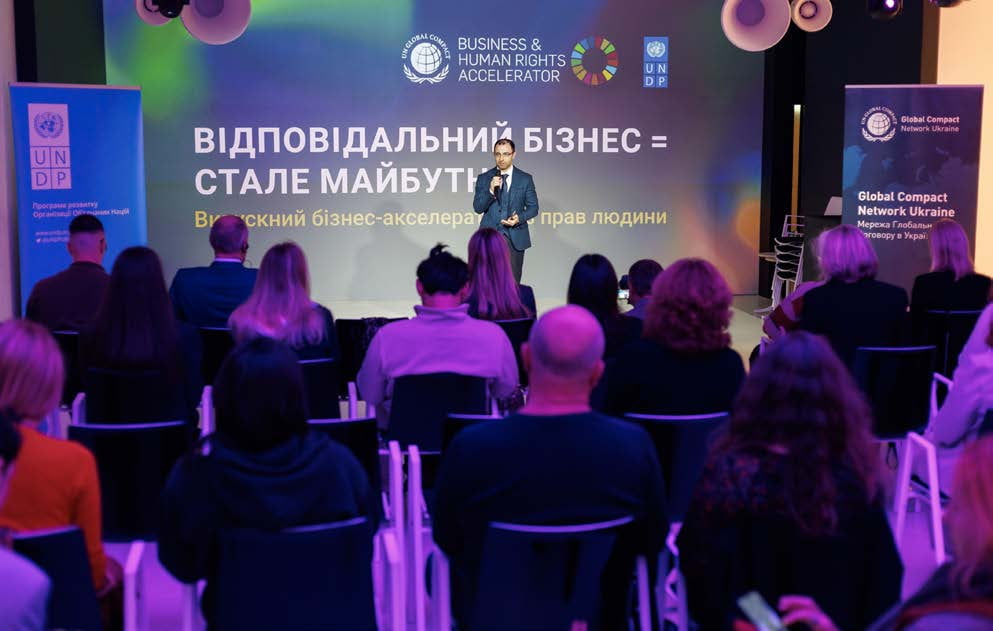
Participants of the human rights business accelerator attended a graduation ceremony in Kyiv.
Insights from the B+HR Academy spurred concrete steps. In Indonesia, businesses began revising their grievance mechanisms, running internal awareness campaigns on workplace harassment and aligning recruitment language with non-discrimination standards. In Mongolia, companies initiated the update of internal labour regulations and implementation of ongoing human rights due diligence. In Japan, businesses advanced a range of initiatives, from developing human rights risk maps and supplier education programmes to publishing due diligence reports and launching dedicated human rights web-portals.
At the policy level, UNDP supported NAP processes and integrated B+HR into broader development, recovery and sustainability agendas. The partnership’s policy engagement achieved notable progress in 2024. In Kyrgyzstan, UNDP and Japan facilitated a year-long consultation involving nearly 200 stakeholders, culminating in the Government’s formal adoption of the NAP in December 2024. In Nepal, following the adoption of the country’s first-ever NAP in late 2023, UNDP supported national and provincial launch events and dissemination efforts. Kazakhstan finalized a national baseline assessment, laying the groundwork for a newly established Inter-Governmental Working Group on B+HR. In Mexico, sustained stakeholder engagement ensured policy continuity through a government transition, while embedding gender and other cross-cutting considerations into NAP development.
Strong partnerships proved vital for promoting the B+HR agenda. UNDP Country Offices that engaged early with Japanese stakeholders, national chambers of commerce and local business associations achieved greater success in reaching businesses. In many countries, directives from company headquarters also played a critical role in encouraging local subsidiaries to participate.
At the same time, sustaining business action requires follow-up. To address this, UNDP introduced multi-session formats and CEO roundtables to reinforce commitment, foster leadership-level engagement and help businesses to develop realistic workplans.
In some contexts, political turnover and weak institutional coordination slowed progress. In response, UNDP prioritized building a diverse stakeholder ecosystem, bringing together government actors, civil society, business associations and NHRIs. This inclusive approach helped mitigate the effects of political transitions and facilitated provincial-level engagement, particularly in Nepal and Peru.
Looking forward
Looking ahead to 2025, the partnership will continue to strengthen this foundation, supporting governments and businesses in implementing responsible business practices and fostering a more level playing field for companies committed to respecting human rights.
-
Including the Government and LGT Group.