Moldova
Countries & Territories


Key results
- UNDP provided legal counselling, assistance and information to 5,156 individuals, including 3,670 women. This includes 3,600 Ukrainian refugees (2,653 women), helping them to navigate the temporary protection mechanism.
- A multilingual chatbot assisted refugees in understanding their rights and the associated legal implications in Moldova. In addition, the Social Tensions Monitoring Mechanism was piloted as a scalable model for conflict prevention.
- Gender-based violence survivors benefited from stronger legal safeguards. A new Safe Space centre in Ungheni region provided multidisciplinary services to 599 women and accommodation to 106. Five mobile teams helped over 1,000 women and girls address grievances and access support services. Additionally, 77 women, including refugees from Ukraine, were assisted in finding employment through local civil society organizations (CSOs).
In 2024, Moldova made significant progress in its European Union (EU) accession process, demonstrating the country’s commitment to reforms in democracy, justice, and public administration. However, societal divisions were underpinned by low trust in institutions and the 2024 election results, as well as the lack of social cohesion, particularly in the South and North. These divisions have been amplified by hybrid threats that could undermine the democratic stability and jeopardize reform efforts. In addition, Moldova continued to accommodate large numbers of refugees and had to contain inflationary pressure, linked also to the persistent threats to its energy supplies and security.
Moldova’s polarized political landscape underscored the need for governance reforms focused on rule of law, transparency and institutional strengthening. Ensuring the integrity of the justice system remained a priority for the Government, with the vetting of justice professionals expanding to engage judges at the Court of Appeal as well as the prosecutorial branch. Contested by justice cadre, the vetting process advanced slowly, leading to the resignation of nearly half of the Court of Appeal judges as a form of protest against this measure. The effects of these resignations are yet to be assessed.
In 2024, Moldova approved a new National Human Rights Action Plan for 2024-2027, reaffirming its commitment to the international human rights standards. Concerns remain about detention conditions and the treatment of persons with mental disabilities in state care.
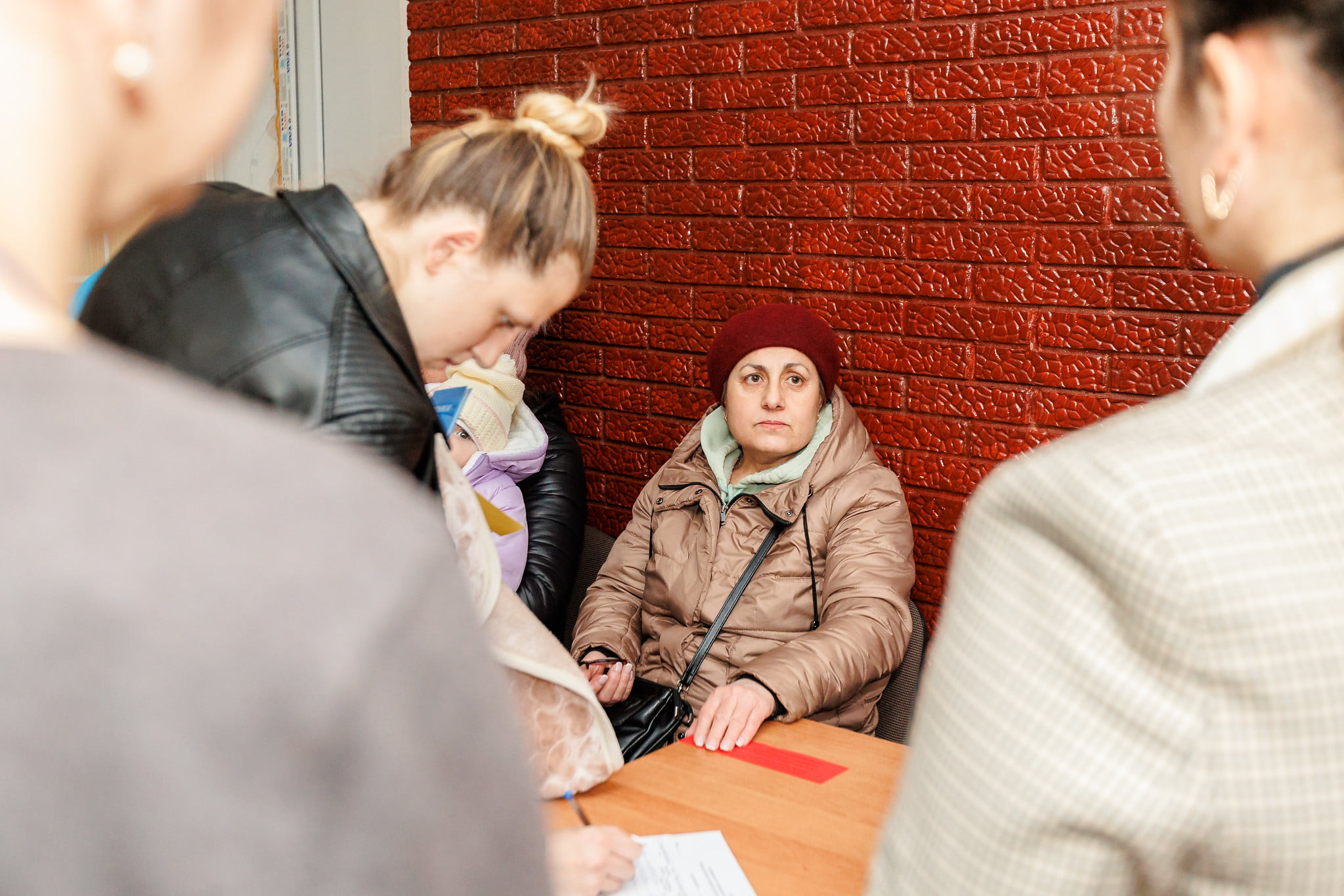
Refugees from Ukraine benefitting from legal assistance and advise on temporary protection mechanism in Moldova.
With support from Germany, Japan and Sweden, UNDP employed diverse approaches to advance the rule of law portfolio in Moldova. Through partnerships with CSOs, UNDP helped 5,156 individuals, including 3,670 women, access justice and support services by providing legal counselling, assistance and information. Nearly 3,600 refugees, including 2,653 women, from Ukraine were assisted in navigating the complexities of the temporary protection mechanism provided by the Moldovan Government.
Technical assistance and technology support from UNDP led to the adoption of various solutions to expand access to legal remedies and information, empowering people to protect their rights. A multilingual chatbot helps refugees to understand their rights in Moldova and the associated legal implications. A tele-assistance platform connects detainees with legal aid service providers to solve legal matters unrelated to their detention. As of December 2024, the National Legal Aid Council was piloting mobile teams to reach more people in need of legal assistance, particularly in remote areas.
The Social Tensions Monitoring Mechanism (STMM) was successfully piloted in 2024, involving local stakeholders and vulnerable groups, and operationalized as a scalable model for conflict prevention and social stability. This evidence-based tool supports trend analysis and enables targeted interventions, demonstrating its value in identifying and addressing social tensions, especially in communities with high refugee populations.
UNDP facilitated the implementation of the International Classification of Crime for Statistical Purposes to enhance the quality and compatibility of crime and criminal justice data produced by national stakeholders. On the policy side, UNDP supported the alignment of Moldova’s legislation with the Council of Europe Convention on Preventing and Combating Violence Against Women and Domestic Violence (the Istanbul Convention). A compliance analysis carried out under the strategic partnership with the CSO Women’s Law Centre revealed critical areas needing improvement, including technology-facilitated gender-based violence. Amendments to 20 national laws were drafted with UNDP support and submitted to the Ministry of Justice for review.
Gender-based violence survivors benefited from stronger legal safeguards, including the revised Regulation on Medical Assessment of the Severity of Bodily Injuries, which now considers the psychological effects of violence and includes mandatory reporting of domestic violence cases. A new Safe Space centre providing multidisciplinary services to gender-based violence survivors was established in Ungheni region in 2024, benefiting 599 women and providing accommodation to 106. Five mobile teams, operationalized with UNDP support, helped over 1,000 women and girls address grievances and access support services. Additionally, 77 women, including refugees from Ukraine, were assisted in finding employment through local CSOs. These civil society-led services complement the work of national authorities, including the National Employment Agency, by providing tailored support and bridging gaps in access to job opportunities.
Looking forward
UNDP will continue to strengthen access to justice and legal remedies for the most vulnerable by expanding legal aid tools, promoting mediation and supporting legal empowerment initiatives. Forensic capabilities will be further strengthened to ensure justice users have access to reliable expertise compliant with international standards. UNDP will assist Moldova in implementing comprehensive justice reforms, incorporating a people-centred perspective into future justice policy documents. The STMM will be further operationalized to support conflict prevention and social stability, helping Moldova to build a robust rule of law system and promote human rights.