
Guinea-Bissau
Countries & Territories


Key results
- UNDP, UNICEF and national partners brought legal and registration services directly to remote communities through a mobile justice initiative. Over 3,200 people (including 1,569 women) received civil registration documents. Among them, over 2,000 people gained legal identity. The campaign resulted in a mindset shift towards the systematic registration of new births, enhancing access to judicial and administrative services.
- With the Bar Association of Guinea-Bissau and grassroots civil society organizations, UNDP conducted awareness-raising campaigns in 70 rural communities, involving 8,360 people, including 3,940 women.
- A Gender Audit was conducted, generating concrete recommendations to improve gender inclusion in public policies and strengthen women's empowerment. The audit has laid a strong foundation for future efforts to advance gender equality in the country.
- A national network of women legal professionals in Guinea-Bissau was established, providing a platform for women in the legal field to exchange experiences, insights and best practices.
In 2024, Guinea-Bissau continued to face a complex sociopolitical context. The Supreme Court operated under interim leadership, pending the appointment of a new president. Legislative elections were scheduled for November 2025, with preparations underway including efforts to encourage broader political participation. These dynamics presented ongoing challenges for governance and the consolidation of the rule of law.
In this challenging environment, the interventions funded by UNDP’s Global Programme for Strengthening the Rule of Law, Human Rights, Justice and Security for Sustainable Peace and Development (the Global Programme) enhanced access to justice, particularly in remote areas, and advanced women’s empowerment in Guinea-Bissau. UNDP’s innovative approach combined efforts from the Bar Association of Guinea-Bissau (OAGB, acronym in Portuguese) and grassroots civil society organizations (CSOs) to prevent gender-based violence and support the survivors, particularly in rural and marginalized communities. Extensive outreach campaigns led by women’s organizations played a crucial role in raising awareness and enhancing access to justice for women, promoting gender equality and ensuring the inclusivity of legal reforms.
Through strategic collaboration with the OAGB, Judicial Police, Centres of Access to Justice (CAJ) and CSOs such as Rede Nacional de Luta Contra Violência baseada no Género e Criança na Guiné-Bissau (RENLUV) and the Association of Women Jurists of Guinea-Bissau, UNDP conducted awareness-raising campaigns in 70 rural communities, involving 8,360 people (4,420 men and 3,940 women).
The campaigns covered women's and children's rights, mechanisms for reporting sexual and gender-based violence, sexual and reproductive health, female genital mutilation, early and forced marriage, avenues for traditional and formal justice, and law, with a focus on women's rights to access land.
To bring legal and registration services directly to remote communities and to promote a culture of justice and active citizenship, UNDP and partners launched a mobile justice initiative. Over 3,200 people (including 1,569 women) received civil registration documents. Among them, over 2,000 people gained legal identity. The campaign resulted in a mindset shift towards the systematic registration of new births, enhancing access to judicial and administrative services. UNDP’s partnership with UNICEF was instrumental in expanding access to justice services for children and youth in remote areas.
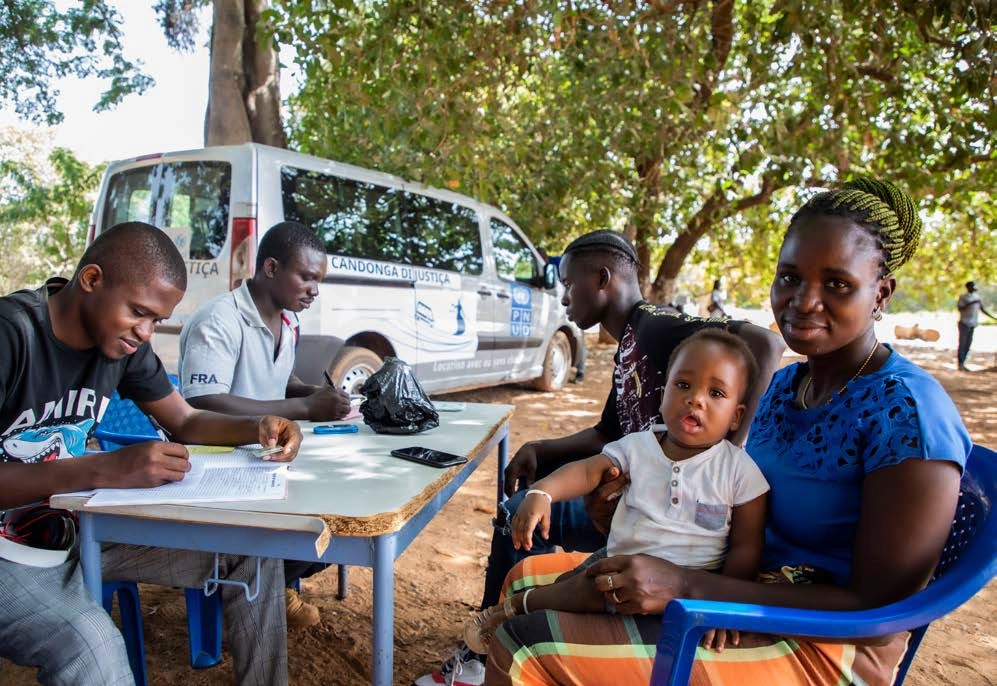
UNDP’s joint mobile justice initiative with UNICEF and national partners resulted in a mindset shift towards the systematic registration of new births, enhancing access to judicial and administrative services.
Within this mobile justice initiative and to further promote a people-centred approach, UNDP engaged local community leaders in radio shows broadcasted via 25 community radio stations across the country. Religious leaders and human rights activists from grassroots CSOs added their voices to the awareness-raising campaign, informing people about their rights, available services, specific events and meetings under the mobile justice initiative. It is estimated that over 150,000 listeners were reached and sensitized nationwide.
In addition, CAJ maintained a strong presence through its seven offices spread across various regions of the country, ensuring constant availability and continued assistance for access to justice. From January 2023 to August 2024, CAJ assisted 7,263 individuals, including 3,253 women.
To identify and address gender equality gaps within the judiciary, a Gender Audit was conducted through a participatory approach that increased stakeholder engagement, contributing to a more comprehensive understanding of gender disparities in the justice system. Despite resource limitations and political instability, the Gender Audit outlined structural barriers for women’s access to justice and generated concrete recommendations to improve gender inclusion in public policies and strengthen women's empowerment. The audit has laid a strong foundation for future efforts to advance gender equality in the country.
A national network of women legal professionals in Guinea-Bissau was established, providing a platform for women in the legal field to exchange experiences, insights and best practices related to gender equality, women's empowerment and human rights within the legal sector. Overall, these initiatives feed into the implementation of UNDP’s Gender Equality Strategy and are supported though the Gender Justice Platform, a UNDP and UN Women partnership.
The support provided by UNDP’s Global Programme had a catalytic effect. The results achieved through this project facilitated greater resource mobilization, particularly with the upcoming €5.85 million support from the European Union to sustain and expand access to justice efforts.
Looking forward
The upcoming Rule of Law project, starting in 2025 for four years, will play a crucial role in sustaining the progress made in access to justice, especially through CAJ and the OAGB. These institutions, which have been key in providing legal aid and support to marginalized communities, will receive further technical and financial support, ensuring their continued operation and expanded reach.
The project will also integrate mechanisms for the recognition of Alternative Dispute Resolution (ADR) systems, further promoting sustainable access to justice for rural and underserved populations. Through continuous collaboration with the Ministry of Justice and civil society, UNDP will foster national ownership and ensure that these services and reforms are institutionalized, thereby maintaining their impact over time.